
How to Use Your Expense Records to Write Better Bids
Use your expense records to build bids with real margin built in. How tracking business costs turns historical spending into accurate project estimates


Most contractors and freelancers price jobs by feel: time estimate, materials, a margin that sounds reasonable. What's usually missing is knowing how to estimate project costs accurately: what the business actually costs to run per week, per job. Without that baseline, bids are built on instinct rather than data, and the jobs that break even or lose money usually aren't client problems. They're information problems.
Expense records fix that.
Your cost baseline lives in your actuals
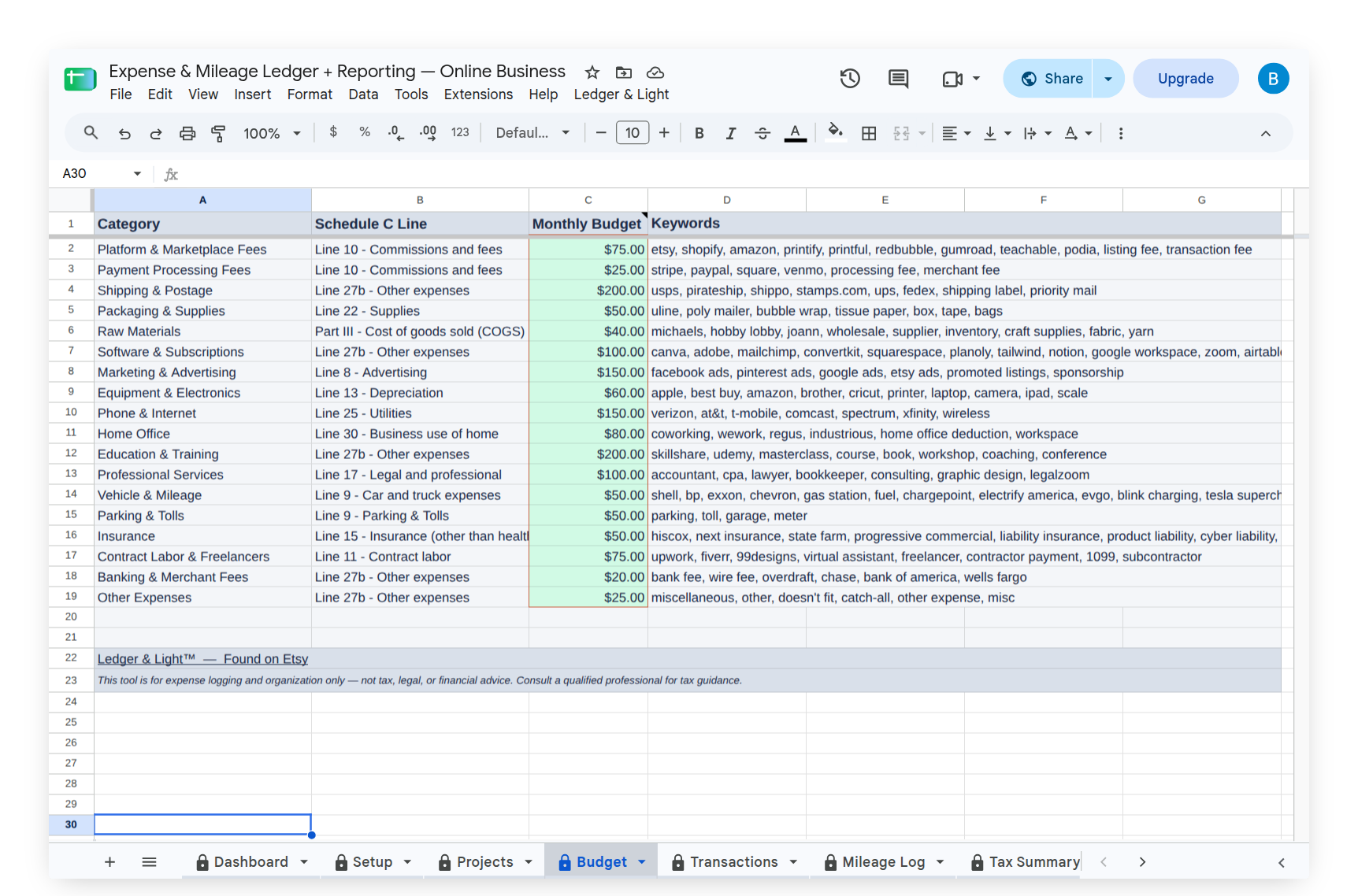
After a few months of logging, your expense records reveal patterns that gut instinct can't. Expense Ledger's Budget tab organizes every expense into the Schedule C expense categories that apply to most solo freelancers and self-employed business owners: supplies, repairs and maintenance, car and truck expenses, office expenses, professional services, and the rest. Once you have three to six months of actuals, you can see what each category costs per month.
That monthly baseline (not what you think it should cost, but what it actually does) is the number missing from most bids.
Supplies is the easiest example. If you've been budgeting $200/month but your actuals show $340 on job-heavy months and $180 on light months, you know your variable materials cost roughly $160 per active project. That number belongs in your bid, not a round guess.
The costs that don't make it into estimates
The categories that most often surprise contractors are the ones that feel like background overhead but actually scale with volume.
Vehicle expenses rise when you're running more jobs. If your car and truck costs average $400/month but hit $600 in busy periods, you're absorbing $200 in real cost that isn't reaching your estimates. At 72.5 cents per mile, that's roughly 276 additional business miles on an active month, miles you're not pricing into the jobs driving them.
Repairs and maintenance often cluster around periods of heavy use. A $900 equipment repair spread across 15 active jobs is $60 per job, invisible until it shows up in the ledger. Left out of estimates, it makes profitable months look like breakeven and breakeven months look like losses.
Professional services (legal fees, subscriptions, professional memberships) are easy to treat as fixed overhead that doesn't belong in job pricing. But they're real monthly costs that every job has to carry. If your professional services category runs $300/month and you complete 10 jobs that month, each job is responsible for $30 in professional services costs whether you account for it or not.
Per-project logging at Premium tier
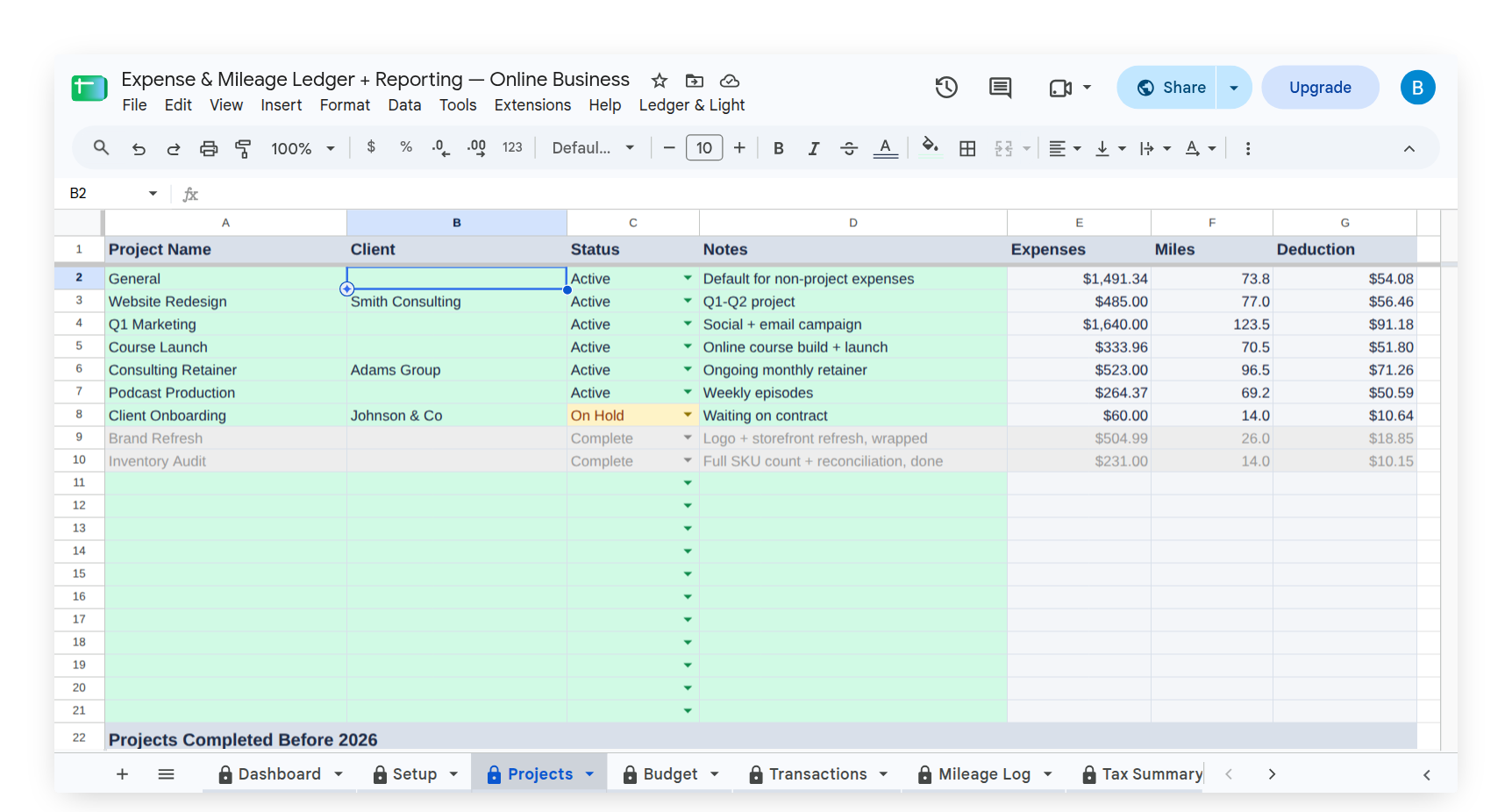
Expense & Mileage Ledger + Reporting includes a Projects tab that lets you log individual expenses against specific jobs: materials purchased for a project, subcontractor costs, job-specific equipment rentals. At the end of a project, you see actual costs per job broken out by category.
That's a dataset for future bids. A job that cost $1,100 in direct materials and 22 hours of labor tells you something the next time a similar job comes in. The estimate starts from a documented number, not a memory of what seemed about right.
Building the estimate
Once you know your monthly overhead baseline and your direct costs per project type, a bid becomes arithmetic rather than intuition.
Direct costs (materials, subcontractors) plus your time at your target rate plus your share of monthly overhead equals your floor price. Add margin above that floor.
The overhead allocation doesn't have to be precise to be useful. A rough split (this job looks like 15% of my monthly capacity, so it carries 15% of my $2,400 monthly overhead, which is $360) is closer than no allocation. Precision improves as your data accumulates.
What changes over time
The first bid you build from real numbers won't be perfect. But it will be built on something real instead of something estimated, and the gap between your guess and your actual closes fast once you're watching it. By the end of year one, the estimate is grounded in documented costs. The jobs that once seemed tight to price are just arithmetic, and the margin isn't a surprise in either direction.