
What to Write in the Business Purpose Field of Your Mileage Log
The IRS requires a business purpose for every mileage log entry. Here's what passes an audit, what gets disallowed, and how to make every entry hold up


The mileage log business purpose field is one of four IRS-required elements per trip, and the one most commonly responsible for audit disallowances. Date, destination, and miles are largely mechanical. They come from the odometer and the submission timestamp. Business purpose is the field the auditor reads to determine whether the trip was actually a business expense.
Why vague entries get disallowed
The IRS requires a contemporaneous record: an entry created at or near the time of the trip, not reconstructed months later. An auditor reviewing a mileage log 18 months after the trips were taken looks at the business purpose field to understand why each drive was a business expense. A vague entry doesn't give the auditor anything to verify.
"Client" and "meeting" are not disallowed because auditors are unreasonable. They're disallowed because they describe a category, not a trip. There is no way to confirm, from the entry alone, which client or which meeting, or whether the trip was a business expense at all.
The 18-month test
A useful standard for any mileage log entry: could a stranger reconstruct the business purpose of this trip from this entry alone, 18 months from now?
If yes, the entry passes. If you'd need to check your calendar, contact a client, or guess, the entry fails. The value of specificity is that the record stands on its own, without the memory.
Short trips make this test harder, not easier. A 6-mile round trip to the hardware store for a job feels self-explanatory in the moment. At audit time, "supply run" with no job context doesn't document a business purpose. It documents a drive to a store. A few words of specific context in the business purpose field is the difference between a deduction that holds and one that doesn't.
What the IRS requires
IRS Publication 463 specifies four elements for each business trip:
- Date of the trip
- Destination: the city, town, or area you drove to
- Business purpose: why the trip was necessary for your business
- Miles driven: or odometer start and end readings
Purpose is not optional and not a formality. It is one of the four statutory requirements. A log with accurate dates and odometer readings can still fail if the purpose entries are blank or generic.
What defensible looks like
The bar isn't a paragraph. It's a short phrase with enough context to establish the business connection:
- "Client meeting, [name], their office" (who and what)
- "Hardware store, materials for [job name]" (where and why)
- "Site inspection, 44 River St, punch list" (where and what)
- "Post office, certified mail for LLC renewal" (action and purpose)
- "Bank deposit, job #47 check" (action and context)
Each of these could be verified by a third party from the entry alone. None of them require memory to interpret.
Contrast with entries that fail: "client," "work," "meeting," "errands," "store run." These name categories, not trips. An auditor has no way to confirm the business connection from any of them.

In the Mileage Form
In the Mileage Form, Business Purpose is a dropdown, not a blank line. It ships with a starter set of common purposes (Client Meeting, Job Site, Supply Run, and a few others), plus "Other" for anything off the list. Those starters are deliberately generic, and on their own they are the kind of category entry an auditor cannot verify.
That is what the Customize Forms tab is for. Open Customize Forms, find the Trip Purposes list, and replace the generic starters with the specific purposes your business actually drives for: "Client meeting, [your regular client], their office," "Materials, [recurring job]," "Bank deposit, job checks." Set it up once, and every trip you log is already defensible straight from the dropdown, with no detail to retype each time.
What to aim for when you build the list: each label covers who, what, or where. "Client visit, downtown office" is enough. "Hardware run, Smith remodel" is enough. A full sentence is never necessary.
For a genuinely one-off trip, pick "Other," then refine the wording in the Mileage Log's Purpose column, which accepts a typed entry. That record is the one part the product leaves to you, and it is the part an audit turns on.
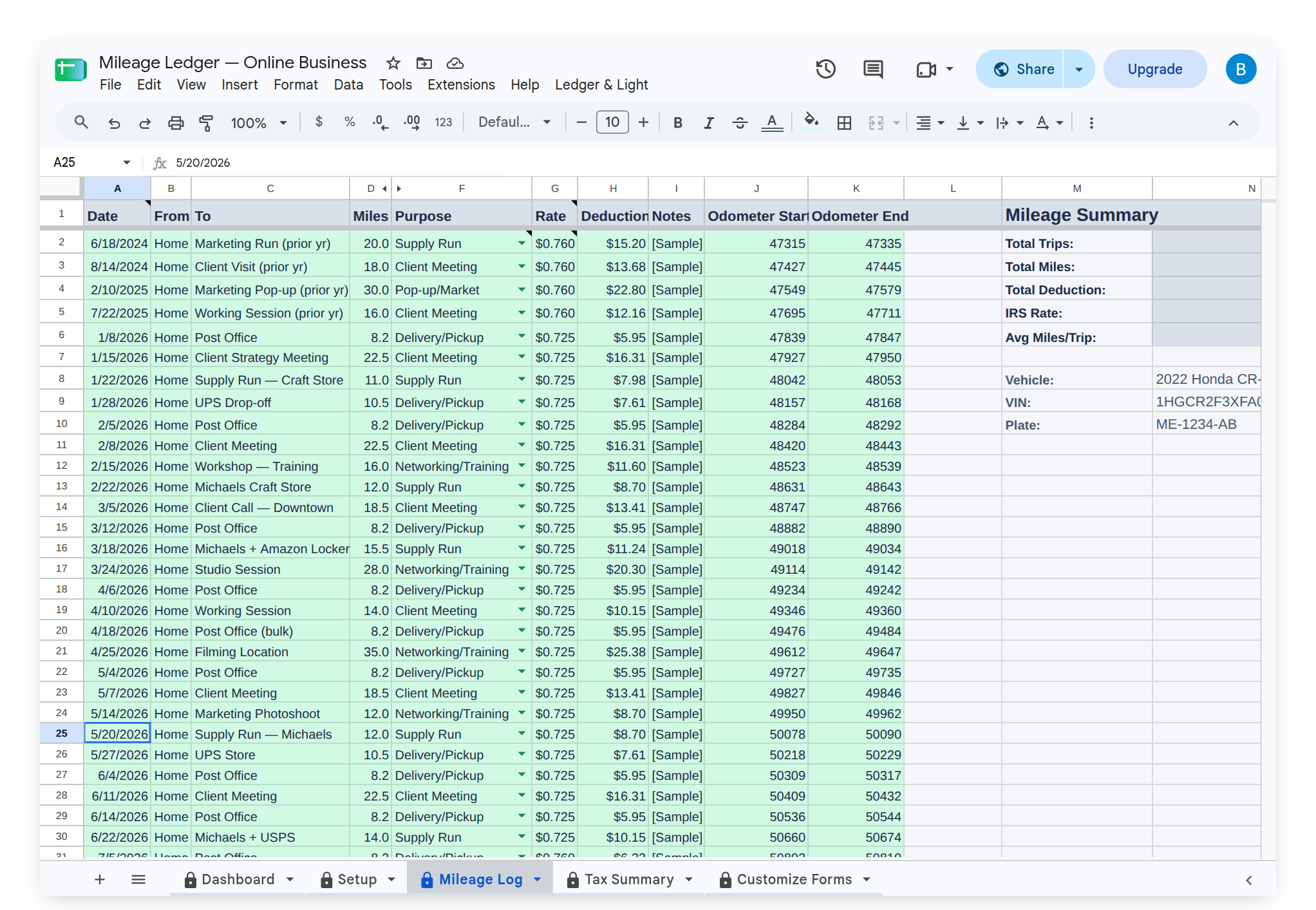
The Mileage Form and Mileage Log are included in Mileage Ledger and Expense & Mileage Ledger. The IRS requirement for business purpose specificity is identical regardless of which product you use or how you log. The quality of the entry is what determines whether a deduction survives an audit.