
Best Expense Categories for Resellers (eBay, Poshmark, Etsy Vintage & Antique Booth Sellers)
The best expense categories for resellers: what each covers, the Schedule C line it maps to, and why the sourcing buy is the line all the rest depend on


A reseller's books are really one question asked eighteen ways: what did this piece actually cost by the time it sold? The sourcing buy is the start of the answer, and the platform fee, the postage, the mailer, the booth rent and the miles driven to find it are the rest. When each of those lands in its own category the day it happens, the answer is already written by the time anyone asks.
The best expense categories for resellers follow the Schedule C lines a secondhand seller actually files. Eighteen of them cover how a reselling business spends — the inventory, the marketplaces, the shipping, the space, the equipment, and the driving that sourcing is built on — and each has a plain definition, so every purchase has one obvious home.
See Reseller Expense Ledger on Etsy ↗
Sourcing & Inventory Purchases — Schedule C: Part III (Cost of goods sold)
Everything bought to resell: the estate-sale haul, the thrift-store run, the auction lot, the flea-market table, the garage sale on a Saturday morning, the wholesale bundle bought online. This is the anchor line for a reseller, because it is the cost that gets matched against the sale. The four-dollar vase that sells for forty-five is a four-dollar cost of goods before a single other expense is counted.
What is still on the shelf at the end of the year
Cost of goods sold is not simply the year's total sourcing spend. Part III starts from the inventory on hand at the beginning of the year, adds the year's purchases, and subtracts the inventory still unsold on December 31. So the pieces sitting in the garage, the storage unit and the booth at year end matter, and an accountant will ask for a year-end count. How that count is valued, and which accounting method suits the business, are questions worth settling with a CPA before the first filing rather than after.
Platform Fees — Schedule C: Line 10 (Commissions and fees)
The marketplace's cut: eBay final value and insertion fees, Etsy listing and transaction fees, Poshmark, Depop, Mercari, Whatnot and Grailed selling fees. Each platform calculates its fee differently, and most show the detail on the payout statement — which is where the figure comes from, because the payout that reaches the bank has usually had it taken out already.
Shipping & Postage — Schedule C: Line 27b (Other expenses)
Labels bought through Pirate Ship, Shippo, Stamps.com or a marketplace's own label tool, plus postage paid at the counter. For a cross-lister this line can grow as large as the fees, and it moves in small amounts nearly every day.
Packaging Supplies — Schedule C: Line 22 (Supplies)
What goes around the piece: poly mailers, padded mailers, boxes, tissue paper, bubble wrap, tape, labels, stickers and thank-you cards, from Uline, Amazon or the office-supply store. Kept separate from postage, so each total reads for what it is.
Payment Processing Fees — Schedule C: Line 10 (Commissions and fees)
The processing cost on sales made outside the marketplaces — PayPal, Square, Stripe, Venmo Business or Cash App Business at a flea-market table, a booth or a direct sale. It shares Line 10 with platform fees, and logging the two separately shows which channel costs what to run.
Storage & Space Rental — Schedule C: Line 20b (Rent or lease)
The storage unit that holds the overflow and the antique-mall booth that holds the stock on display, rented month after month between sales. A one-day vendor fee at a flea market or pop-up is a different kind of cost; whether it belongs here or on another line is worth confirming with a CPA.
Equipment & Electronics — Schedule C: Line 13 (Depreciation)
The tools the listings are made with: a camera or phone used for listing photos, a ring light, a backdrop, a tripod, a thermal label printer, a shipping scale, a clothing steamer, a mannequin, a laptop. Equipment that lasts more than a year is handled differently from supplies that get used up, and how each purchase is expensed or depreciated is an accountant's call — the Ledger's job is to keep the purchases in one place with their dates.
Marketing & Advertising — Schedule C: Line 8 (Advertising)
Promoted listings on eBay, Etsy Ads, Whatnot promotions, and paid social posts. For most resellers this is the promoted-listing spend, and seeing it as its own total shows whether it earns its keep.
Software & Subscriptions — Schedule C: Line 27b (Other expenses)
Cross-listing tools like Vendoo, List Perfectly and Crosslist, an eBay store subscription, a Whatnot seller plan, Canva, and cloud storage for the photo library.
Vehicle & Mileage — Schedule C: Line 9 (Car and truck expenses)
Fuel and charging for sourcing trips when those costs are logged as expenses. For most resellers, though, the driving itself is the larger deduction, claimed by the mile — covered in its own section below.
Parking & Tolls — Schedule C: Line 9 (Car and truck expenses)
The meter outside the estate sale, the parking lot at the auction house, the toll on the way to a market two towns over. These stay separate from the mileage figure and are claimed on top of it.
Professional Services — Schedule C: Line 17 (Legal and professional)
A CPA, a bookkeeper, tax preparation, or legal advice — including help reconciling a 1099-K against what the business actually earned.
Education & Training — Schedule C: Line 27b (Other expenses)
Price guides like Kovel's, research subscriptions like WorthPoint, reference books on a category of antiques, a reseller course, a conference or coaching.
Phone & Internet — Schedule C: Line 25 (Utilities)
The business share of a phone plan and home internet. The phone is where listings are photographed, cross-listed and answered, so the business share is real, and it is the business percentage only that belongs here.
Home Office — Schedule C: Line 30 (Business use of home)
The home costs behind a room used for the business — often the inventory and photography room — at the share of the home that room represents: a portion of rent or mortgage interest, utilities, and homeowner's or renter's insurance. A room has to be used regularly and exclusively for the business to count, so a spare room that also keeps a guest bed is a question for a CPA before it goes on a return.
Banking & Merchant Fees — Schedule C: Line 27b (Other expenses)
Monthly business-account fees, PayPal withdrawal fees, wire fees and check-processing charges — small amounts that add up over a year.
Business & Inventory Insurance — Schedule C: Line 15 (Insurance, other than health)
General liability for a booth or a market table, and contents coverage for the inventory sitting in a storage unit or a spare room.
Other Expenses — Schedule C: Line 27b (Other expenses)
The costs the other seventeen cannot hold: a business license, a seller's permit or resale certificate, an authentication fee on a designer piece, a consignment payout.
The 1099-K is where the conversation starts, not where it ends
Marketplaces report a seller's gross sales to the IRS on Form 1099-K once the reporting threshold is met. That gross figure is always larger than the business's profit — it includes the cost of the pieces sold, the fees the platform already kept, and the postage. The categories above are how the difference is shown: cost of goods sold, fees, shipping and every operating expense, each on its own line, reducing the gross to the real number.
This applies to a business that buys items in order to resell them. Someone clearing out things they already owned is in a different situation, and the line between the two is worth confirming with an accountant.
Sourcing is the drive
For a reseller, the trip is not overhead on the way to the work — it is the work. Four estate sales before noon, a thrift stop in the next town over, the flea market on Sunday, the post office on the way home. Every leg of a sourcing route is business driving, and at the IRS standard mileage rate a year of those routes adds up to one of the largest deductions the trade has.
Expense & Mileage Ledger and Expense & Mileage Ledger + Reporting add a Mileage Form and a Mileage Log for exactly this. A trip is logged when it ends — date, destination, purpose, miles — and the year's total builds itself. The trip purposes come pre-set for the work: Estate Sale, Thrift Sourcing, Post Office Shipping, Auction/Flea Market, Supply Run, and Bank/Post Office.
The standard rate absorbs fuel, maintenance, insurance and depreciation. It does not absorb the parking meter or the toll, which are logged under Parking & Tolls and claimed on top of the mileage deduction.
Categories already built for the work
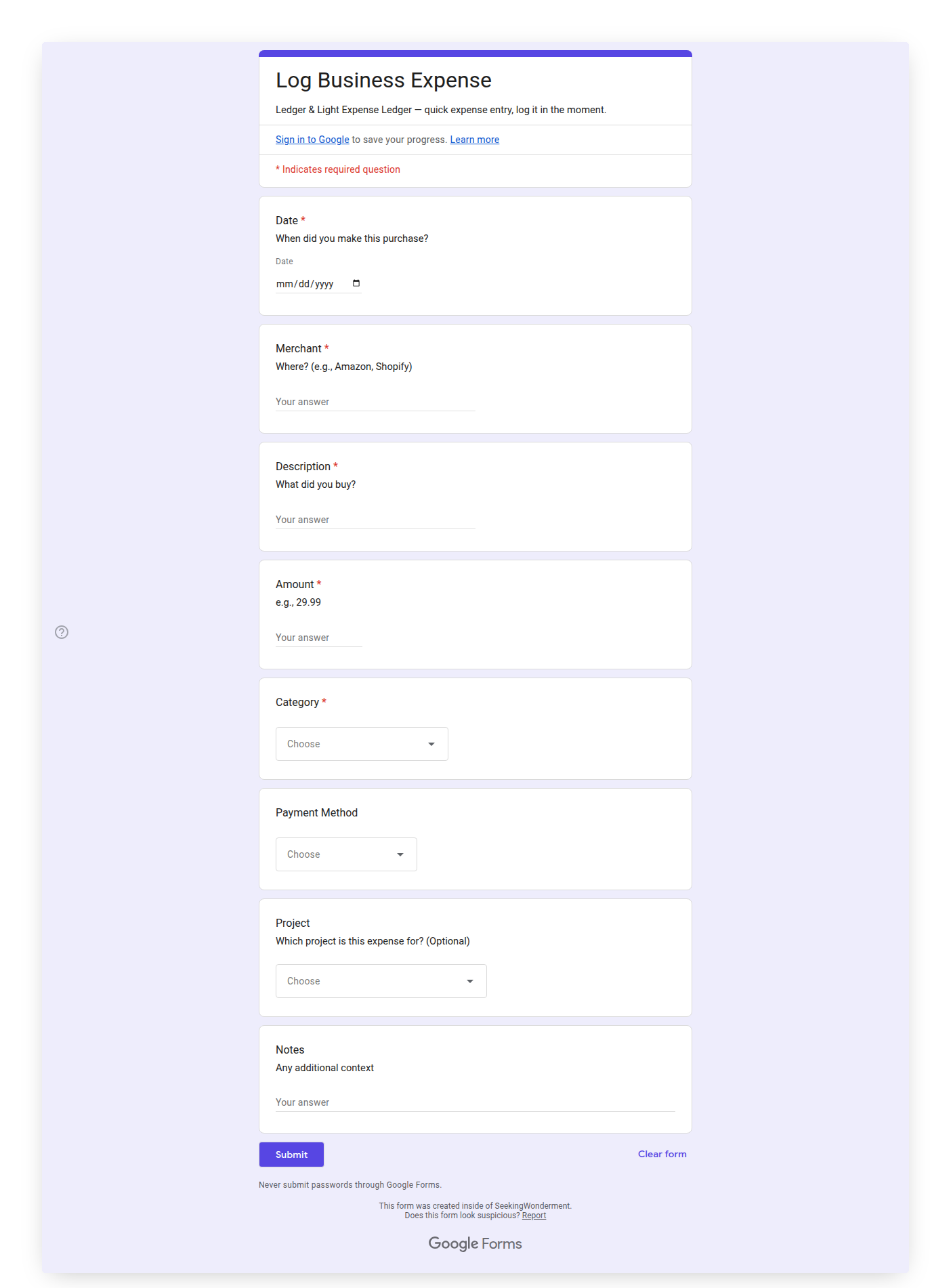
Expense Ledger arrives with the reseller categories already built — the eighteen above, in the Expense Form's dropdown, each mapped to the Schedule C line it belongs to. There is no category list to configure. A purchase is logged from a phone in a minute or two, right at the checkout table: the merchant, the amount, the category, a short note, and a photo of the receipt or the sale tag through the form's receipt photo upload field, which is switched on once during setup because Google requires that step to be done by hand.
The Transactions tab gathers the year as it happens, and the Tax Summary tab shows a running total for every Schedule C line — so the year's sourcing total is already added up when the year-end inventory count begins, and the fees, postage and booth rent are sitting where an accountant expects to find them.
It is a one-time purchase with no subscription, it lives in a personal Google Drive, and every entry carries its own date, past dates included — so starting mid-year still puts each cost in the right tax year through the year filter.
For the year-end handoff, Expense & Mileage Ledger + Reporting adds Email Tax Report, which sends an accountant the Tax Summary, the full transaction list and the year's Mileage Log as PDFs in a single email, plus Tab Export, which saves any individual tab to Drive as a PDF.
What Expense Ledger does not do is count or value the year-end inventory. That count comes from the shelves, the storage unit and the booth. The Ledger's job is to make sure the purchases it is measured against are complete, sorted and dated.
Log the buy when the money goes out, pick the category, and log the route when the drive ends. Do that through a year and the question a reseller's return asks — what did it cost to find, list and send each piece — already has its answer.
This article is general information rather than tax or legal advice. The year-end inventory count, the accounting method, the home-office test and the business-versus-casual question are all worth confirming with an accountant.
Reseller Expense Ledger on Etsy
Common questions
What are the best expense categories for resellers?
Eighteen categories follow the Schedule C lines a reseller files. They cover Sourcing & Inventory Purchases, Platform Fees, Shipping & Postage, Packaging Supplies, Payment Processing Fees, Storage & Space Rental, Equipment & Electronics, Marketing & Advertising, Software & Subscriptions, Vehicle & Mileage, Parking & Tolls, Professional Services, Education & Training, Phone & Internet, Home Office, Banking & Merchant Fees, Business & Inventory Insurance and Other Expenses.
Which expense is the anchor line for a reseller?
Sourcing & Inventory Purchases. It sits in Part III, cost of goods sold, and it is the cost matched against each sale. The four-dollar vase that sells for forty-five is a four-dollar cost before any other expense is counted.
Is shipping postage separate from packaging supplies?
Yes. Postage and labels go under Shipping & Postage on Line 27b, and mailers, boxes, tissue and tape go under Packaging Supplies on Line 22. Kept apart, each total reads for what it is.
Are parking and tolls part of the mileage deduction?
No. The standard mileage rate covers fuel, maintenance, insurance and depreciation, but not the parking meter or the toll. Those are logged under Parking & Tolls and claimed on top of the mileage deduction.
Does the Expense Ledger count the year-end inventory?
No. The year-end inventory count comes from the shelves, the storage unit and the booth, and its valuation is an accountant's call. The Ledger keeps the purchases that count is measured against complete, sorted and dated.