
Best Expense Categories for Child Care Providers (Home Child Care, Group Child Care Homes & Child Care Centers)
The best expense categories for daycare and family child care work, what each one covers, the Schedule C line it maps to, and where home costs land


A child care day produces more deductions than it produces paperwork. The snack tray, the box of art paper, the renewed CPR card, the disinfectant, the share of the electric bill that kept six children warm — all of it is ordinary, all of it is deductible, and most of it arrives in small, frequent amounts, which is exactly the kind of spending a named category set is built to gather up.
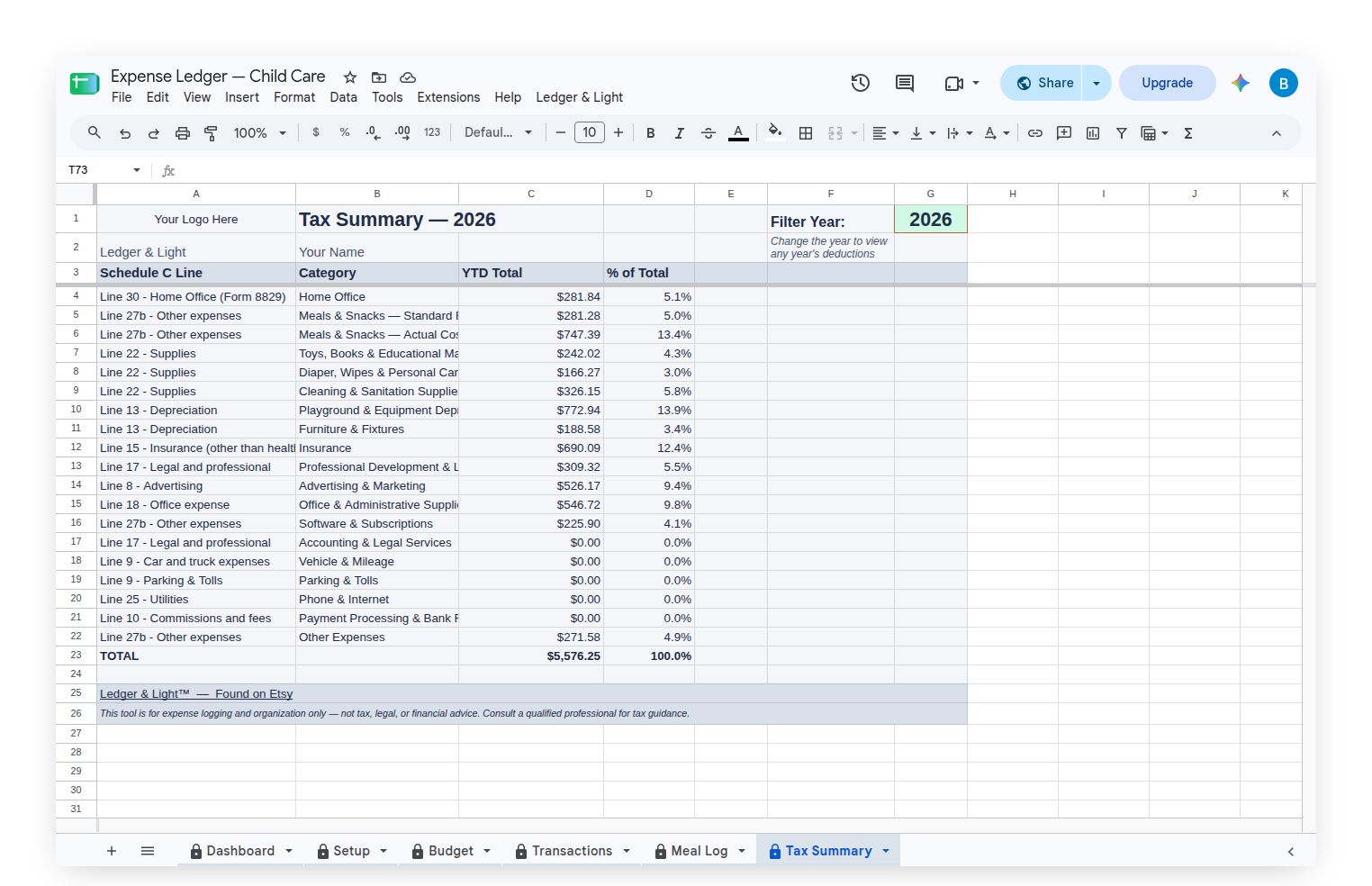
The best expense categories for child care map to the Schedule C lines a self-employed provider actually files. Nineteen of them cover how a family child care business spends: the food served, the supplies used up, the equipment that lasts, the licensing and screening that comes around every year, the share of the home the business uses, and the driving in between. Each one has a clear definition, so every purchase lands in the right place from the day it is logged.
Home Office — Schedule C: Line 30 (Business use of home, Form 8829)
The home costs a child care business carries: mortgage interest or rent, utilities, homeowner's or renter's insurance, property tax, and general repairs to the space where care happens. Child care sits in one of the narrow exceptions to the exclusive-use rule that governs every other home office, so a room the family also uses in the evening still counts. The deductible share is not the whole bill and it is not the room's share of the floor plan either — it is the time-space percentage, and it belongs to the section below.
How much of the home counts, and why the answer is personal
Two fractions decide it, and they are multiplied rather than swapped. Space is the square footage regularly used for the business divided by the home's total square footage. Time is the hours the home was used for the business during the year divided by the hours in the year, counting the work done inside the home when no children are present — meal preparation, cleanup, setting out the next day, keeping the records. The product of the two is the fraction that applies to the whole-home costs on Form 8829.
Because it is a fraction of a fraction, the answer always sits below the space figure on its own. There is no general percentage to borrow: two providers on the same street, in identically sized homes, arrive at two different numbers and both are correct. The full method, with worked examples that print their own inputs so any of them can be swapped for a real one, is in the companion article The Time-Space Percentage: How Much of Your Home Counts.
Two things belong with a CPA before the percentage is calculated at all. The exception is tied to licensing status — a provider licensed, certified, registered, or approved under state law, or exempt from those requirements — and what counts as exempt is a state question rather than a federal one. And a room set aside for the business and nothing else is handled differently from the rooms the family shares, which puts a second calculation on top of the first; that split is worth walking through against the current Publication 587 worksheet rather than assumed. If the home is owned, depreciating the business share also has consequences when the home is sold, which is a conversation worth having early.
Meals & Snacks — Standard Rate (Meal Log) — Schedule C: Line 27b (Other expenses)
The standard meal and snack allowance, which is the method most home providers land on. Instead of proving which groceries were business groceries, the provider records what was actually served — breakfasts, lunches, suppers, snacks — and each count is multiplied by the published rate for that meal type. The rates are the USDA CACFP Tier I reimbursement rates, and a provider does not have to take part in the food program to use them. No food receipts are needed for the meals that were served. The Meal Log tab holds the counts, and the total is claimed among the other expenses listed in Part V of Schedule C, which carries to Line 27b. Food served to children is not a Line 22 supply consumed in the business, and it is not the ordinary business-meal line either, which is limited to half the cost.
Meals & Snacks — Actual Cost — Schedule C: Line 27b (Other expenses)
The other side of the same election: milk, cheese and yogurt, fresh fruit and vegetables, whole grain bread and cereals, peanut butter, eggs and chicken, deducted at what they actually cost. This method needs the grocery receipts and a defensible way to separate the food served to the children from the food the household ate, which is the harder half when one cart at one store feeds both. It lands on the same line as the counted allowance: the food is the same expense either way, and Part V is where Pub. 587 puts it however the figure was arrived at.
One meal method for the year, not two
The two meal categories above are an either-or, and the choice belongs to the provider. In any one tax year only one of them should carry a figure — the second category exists because the election can be revisited from year to year, not because both get filled in. What they are not is two different deductions. Counting the meals and keeping the grocery receipts are two ways of valuing one expense — the food served to the children — so both land in Part V and carry to Line 27b. The method changes how the figure is arrived at, never where it goes.
Three details are worth settling with a CPA before the first count is recorded: how many meals and snacks of each type count for one child in one day, whether the chosen method has to be applied to every eligible child for the whole year rather than mixed meal by meal, and how the provider's own children and the provider's own meals are handled under each method. One more sits on the income side rather than the expense side: money received from the food program is generally income to the business, with an exception for amounts received for the provider's own children, and how that is reported is an accountant's question.
Toys, Books & Educational Materials — Schedule C: Line 22 (Supplies)
Picture books and board books, building blocks, puzzles and learning games, and the art supplies that get used up — crayons, markers, construction paper, glue sticks, safety scissors. These are bought and consumed inside the year, so they are deducted in the year they are bought. Small individually, and a real number across twelve months of restocking.
Diaper, Wipes & Personal Care Supplies — Schedule C: Line 22 (Supplies)
Diapers by the case, name brand or store brand, plus wipes, baby shampoo and lotion, hand sanitizer and soap. This is the most predictable recurring purchase in an infant and toddler program, and giving it its own category makes the yearly figure visible instead of scattered.
Cleaning & Sanitation Supplies — Schedule C: Line 22 (Supplies)
Disinfectant wipes and spray, laundry detergent for the cots, sheets and towels the program uses, paper towels, and trash bags. Health and safety rules make these ordinary and necessary rather than optional, which is exactly what a business expense is. Property that serves both the business and the family — a washing machine, a sofa, a television — is a different question: those are generally deductible at a business-use percentage rather than in full, and which percentage fits a given item is worth asking a CPA.
Playground & Equipment Depreciation — Schedule C: Line 13 (Depreciation)
The outdoor swing set, the sandbox and its cover, an indoor climbing structure, the picnic tables in the play area. Equipment that lasts well beyond the year it is bought has its cost recovered over time rather than deducted the day it is paid for. Section 179 and the de minimis safe harbor both apply here in the ordinary way, but the amounts that decide which purchases they cover are set by regulation and revised, so they are read for the filing year and the call on a specific purchase belongs to a CPA. Logging it here either way is what lets an accountant make that call with the facts in front of them.
Furniture & Fixtures — Schedule C: Line 13 (Depreciation)
The same treatment for the furnishings a program is built out of: child-sized tables and chairs, shelving units for toy storage, cots and nap mats, and cabinet organizers. Same test as above — an item that serves the business for years is recovered over years, and where the line falls between an item expensed now and an item capitalized is a filing-year question for an accountant rather than a fixed number to memorize.
Insurance — Schedule C: Line 15 (Insurance, other than health)
The policies a child care business runs on: child care liability insurance written for this work rather than for generic small business, and the abuse and molestation coverage that is conventionally excluded from a general liability policy and bought as a separate endorsement or rider. A typical homeowner's policy typically excludes business activity conducted in the home, so a home-based provider generally carries a rider or a separate commercial policy for property damage arising from the program. Premiums are deductible in full, and a named category keeps a monthly premium out of a catch-all.
Professional Development & Licensing — Schedule C: Line 17 (Legal and professional)
The recurring cost of staying qualified: state licensing or registration renewal, criminal history and registry background checks for the provider and the other adults in the household, CPR and pediatric first aid certification, and the annual training hours most states set in child development, health and safety, and nutrition. Conference fees and course materials belong here too. A note worth raising with a CPA: licensing fees and continuing education are sometimes placed on the taxes-and-licenses line or the other-expenses line rather than legal and professional, and the total deduction is the same either way — it is the Schedule C mapping an accountant may prefer to see stated one particular way.
Advertising & Marketing — Schedule C: Line 8 (Advertising)
Anything spent to bring the next family through the door: Facebook and Instagram ads aimed at enrolling, listings in local child care directories, printed flyers and brochures, and the website domain and hosting. If it was paid to reach a parent who is looking, it belongs on Line 8.
Office & Administrative Supplies — Schedule C: Line 18 (Office expense)
The paperwork a licensed program runs on: parent communication notebooks and forms, attendance sheets and incident reports, printer ink and paper, file folders and a label maker. Unglamorous, required, and deductible.
Software & Subscriptions — Schedule C: Line 27b (Other expenses)
The recurring digital costs: a parent communication app such as Brightwheel, child care management software such as Procare, payroll software if there is anyone to pay, and an office suite. These bill automatically, which is precisely why a named category earns its place — it keeps the annual total in plain sight. Line 18 covers office supplies and postage, which a subscription is not, so software is listed among the other expenses in Part V and carried to Line 27b — a different line from the notebooks and printer ink above, and a separate figure worth reading on its own.
Accounting & Legal Services — Schedule C: Line 17 (Legal and professional)
Fees paid to the professionals who keep the business sound: a tax preparer or accountant for the Schedule C filing, a bookkeeper, and an attorney for an enrollment contract review, a business formation question, or a zoning question about care in a residential home. Keep each invoice with its date and a short note on what the work was.
Vehicle & Mileage — Schedule C: Line 9 (Car and truck expenses)
Every business drive in the provider's own vehicle, claimed at the IRS standard mileage rate: the grocery and supply run, the field trip or outing with the children, the equipment pickup, the drive to a training course, the licensing or compliance visit, the bank and post office. Because a home-based provider's home is the principal place of business, the trip to the warehouse store is a business mile from the driveway. For a provider who also keeps an outside office or works a second location, whether a particular drive is a business mile is worth confirming with a CPA. The standard rate already absorbs fuel, maintenance, vehicle insurance and depreciation, so those are not claimed a second time — the miles are the deduction.
Parking & Tolls — Schedule C: Line 9 (Car and truck expenses)
The meter at a field trip destination, the garage downtown, the highway or bridge toll on the drive to a training day, the transponder charge. These ride on the same Schedule C line as mileage, and they are the part of driving the standard rate does not absorb — which is why they carry their own category and why they are claimed on top of the mileage figure rather than instead of it.
Phone & Internet — Schedule C: Line 25 (Utilities)
The business-use share of the phone that takes the parent calls and texts, and of the home internet that carries the parent app, the licensing paperwork and the training modules. A line used partly for personal reasons is deductible at its business-use percentage; a dedicated business line is deductible in full. Note that this is a different fraction from the one that governs the home costs on Line 30 — a phone and an internet connection are allocated by business use, not by the time-space percentage.
Payment Processing & Bank Fees — Schedule C: Line 10 (Commissions and fees)
The slice taken out of tuition before it lands: processing fees inside a parent app such as Brightwheel or Procare, business transaction fees on peer-to-peer payments, the monthly business checking charge, check printing, and returned-item fees. Tuition arrives every week or two, so these accumulate quietly across the year and a named category is what makes the annual figure visible.
Other Expenses — Schedule C: Line 27b (Other expenses)
The genuine leftovers with no home above: association dues, a small permit, postage on an enrollment mailing. One thing that looks like it belongs here usually does not — for a sole proprietor a charitable donation is generally a personal itemized deduction rather than a business expense, so where a gift belongs is worth asking a CPA before it is logged as a cost of the business.
When there is a second adult in the room
State ratio rules mean a growing program eventually pays somebody: an assistant, a substitute for a sick day, a summer helper. Whether that person is a contractor or an employee is a genuine classification question with payroll-tax consequences on both sides, and it is answered before the first payment rather than after, with a CPA. It is worth raising early precisely because the answer decides which forms exist for the rest of the year.
The driving between the errands
Child care driving is steady rather than seasonal — a grocery run before nap time, a field trip in the spring, a licensing visit a few times a year, a training course on a Saturday. Each of those is a business trip, and at the IRS standard mileage rate a year of them is a real number that leaves no paper behind on its own.
Expense & Mileage Ledger and Expense & Mileage Ledger + Reporting add a Mileage Form and a Mileage Log for exactly this. A trip is logged when it ends — date, where it went, the purpose, the miles — and the year's total builds itself. The trip purposes come pre-set for the work: Grocery/Supply Run, Field Trip/Outing with Children, Childcare Equipment Pickup, Professional Development Training, Licensing & Compliance Visit, and Bank/Post Office.
And the parking stays separate. The standard rate absorbs fuel, maintenance, insurance and depreciation; it does not absorb the meter at the museum or the toll on the way to a conference. Those are logged as expenses under Parking & Tolls and claimed on top of the mileage deduction.
Categories already built for the work
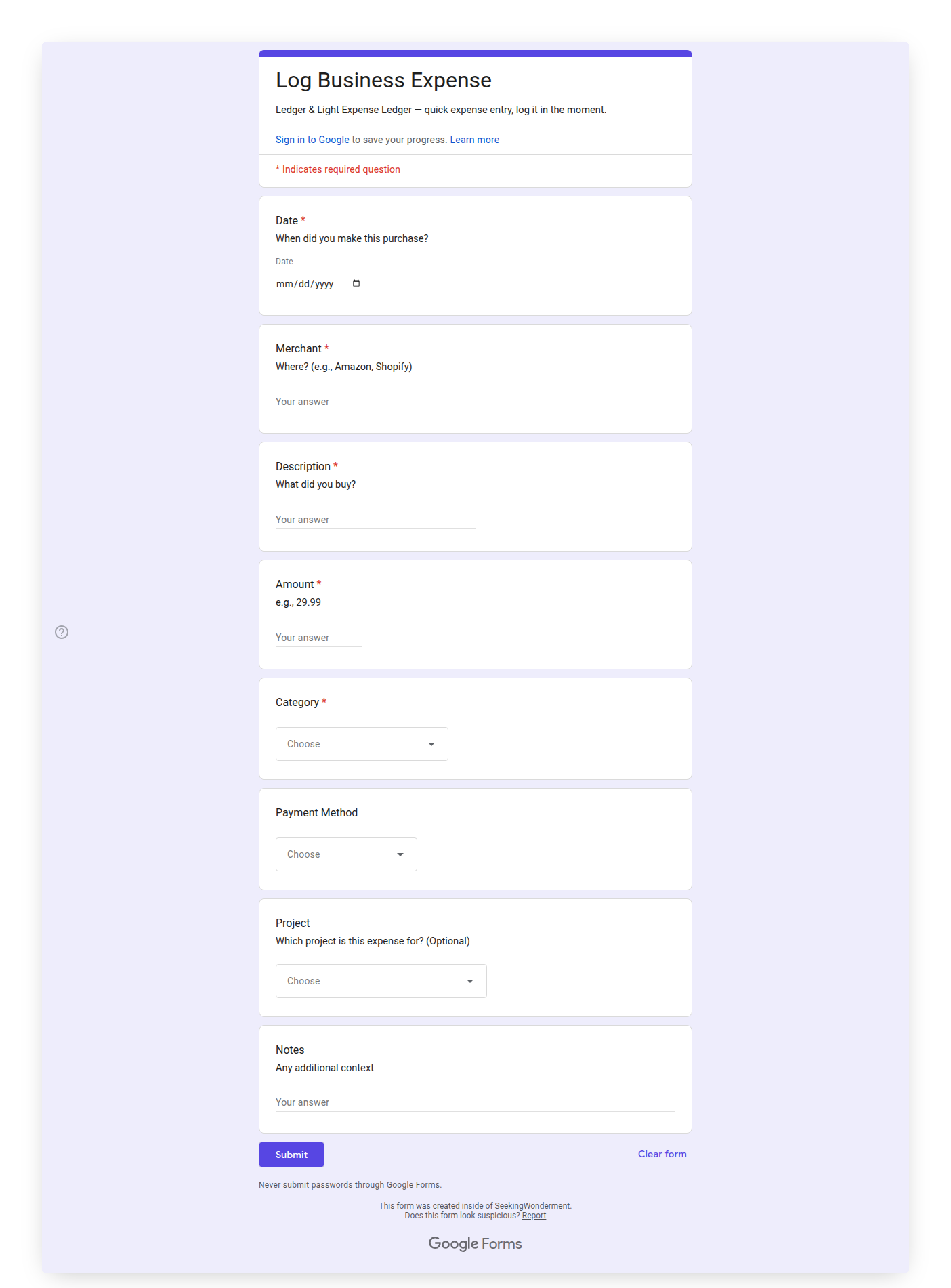
Expense Ledger arrives with the child care categories already built — the nineteen above, in the Expense Form's dropdown, each mapped to the Schedule C line it belongs to. There is no category list to configure. A cost is logged from a phone in a minute or two: the merchant, the amount, the category, a short note, and a photo of the receipt through the form's receipt photo upload field, which is switched on once during setup because Google requires that step to be done by hand.
The Transactions tab gathers the year as it happens, and the Tax Summary tab shows a running total for every Schedule C line, organized the way a return is organized — so the whole-home totals that the time-space percentage gets applied to are already added up when Form 8829 comes out, and the licensing, insurance and supply figures are sitting where an accountant expects to find them.
It is a one-time purchase with no subscription, it lives in a personal Google Drive, and a single file holds around thirteen years of records. Every entry carries its own date — past dates included — so a provider can start in the middle of a school year and each cost still lands in the right tax year through the year filter.
For the year-end handoff, Expense & Mileage Ledger + Reporting adds Email Tax Report, which sends an accountant the Tax Summary, the full transaction list and the year's mileage log as PDFs in a single email, plus Tab Export, which saves any individual tab to Drive as a PDF or PNG, auto-named by year. Want to hand your accountant everything in one send? That is what Expense & Mileage Ledger + Reporting does.
What Expense Ledger does not do is calculate the time-space percentage or prepare Form 8829. That fraction comes from a provider's own square footage and a provider's own hours record, and the form belongs on the return. The Ledger's job is to make sure the costs it applies to are complete, sorted and dated.
Log the cost when the money goes out, pick the category, and record the meals as they are served. Do that through a year and the return is largely written: the supplies on their line, the equipment on its own, the licensing and the liability rider where an accountant looks for them, the miles totalled, and the home costs gathered and waiting for the percentage that belongs to that particular home.
This article is general information rather than tax or legal advice. The time-space percentage, the licensing status behind it, the meal method, and the status of anyone paid to help are all worth confirming with an accountant.