
The Time-Space Percentage: How Much of Your Home Counts (Family Child Care & Home Daycare)
The time-space percentage sets how much of a home daycare's rent, utilities and insurance is deductible, and why every provider lands on a different number


The living room counts. So does the kitchen, and the hallway the children walk down on their way to the yard. A home used for child care is one of the few places the tax code lets a business and a family share the same square footage without the business losing its claim on it, and the time-space percentage is the number that says how much of that home's cost belongs to the business. It is a personal figure. Two providers on the same street, in houses of the same size, will arrive at two different percentages, and both will be right.
Why the usual home-office rule does not apply here
The ordinary home-office deduction is built on exclusive use. A room, or a clearly marked part of one, has to be used only for business. That single condition is what settles most home-office questions before they start.
A qualifying child care provider sits in one of the narrow exceptions written into the rules. IRS Publication 587 covers business use of a home, and its daycare-facility provisions let a provider count space that is used regularly for the business even though the family also uses it in the evening. The result flows onto Form 8829 and from there to Line 30 of Schedule C. This is the most valuable fact in the trade, and the intuition it corrects, that a room the family lives in cannot also be a business room, is exactly backwards here.
The exception is tied to status rather than to intent. It applies to a provider who is licensed, certified, registered, or approved under state law to care for children, or who is exempt from those requirements. What counts as exempt is a state question, not a federal one, so it is worth confirming with a CPA that the licensing status supports the exception before any percentage gets calculated at all.
How the time-space percentage is calculated
Two fractions, multiplied together.
Space percentage is the square footage regularly used for the business divided by the total square footage of the home.
Time percentage is the number of hours the home was used for the business during the year divided by the total number of hours in the year, which is 8,760 in an ordinary year and 8,784 in a leap year.
Multiply the two and the product is the time-space percentage. That fraction is what gets applied to whole-home indirect costs on Form 8829: rent or mortgage interest, gas and electricity and water, homeowner's or renter's insurance, property tax, general repairs, and home depreciation for a provider who owns.
The price of waiving exclusive use is that second fraction. An ordinary home office computes one number. A child care provider computes two, and because a fraction times a fraction is smaller than either one, the answer sits well below the space figure on its own.
The hours that are easy to leave out
The hours counted are not only the hours children are present. Time spent on the business inside the home when no children are there counts as well, provided the space is available for business use. Preparing meals, cleaning up afterward, setting out the next day's activities, keeping the records, and meeting with parents are all business use of the space.
Counting only the stretch from first drop-off to last pickup produces a smaller number than the year actually supports. The hours worth writing down start before the children arrive and finish after they leave.
Three providers, three percentages
Each of these shows its own inputs, so any of the four numbers can be swapped for a real one.
A full-day family provider. She regularly uses 1,400 square feet of a 2,000 square foot home, so her space percentage is 70%. The business day runs 10.5 hours, five days a week, 50 weeks a year, which is 2,625 hours, and she adds roughly an hour a day of prep, cleanup and record-keeping for another 250, giving 2,875 business hours. Against 8,760 hours in the year that is a time percentage of about 32.8%. Multiplied together, 70% of 32.8% is a time-space percentage of about 23%.
A before-and-after-school program. She regularly uses 600 square feet of a 1,600 square foot home, so her space percentage is 37.5%. Care runs two hours in the morning and three in the afternoon, five days a week, across a 38 week school year, which is 950 hours, plus about half an hour a day of setup and records for another 95, giving 1,045 business hours. That is a time percentage of about 11.9%, and 37.5% of 11.9% is a time-space percentage of about 4.5%.
A drop-in provider with an irregular schedule. She regularly uses 900 square feet of a 1,500 square foot home, so her space percentage is 60%. Her hours cannot be built from a weekly pattern because there isn't one, so she writes them down as they happen and the year comes to 1,600 hours of care plus 200 hours of preparation and record-keeping, giving 1,800 business hours. That is a time percentage of about 20.5%, and 60% of 20.5% is a time-space percentage of about 12.3%.
None of those three numbers is a benchmark, and none of them is a starting point for anyone else. What travels between them is the method. Notice too that not one of the three matches its own space figure. Homes that were 70%, 37.5% and 60% business by area came out at 23%, 4.5% and 12.3% by cost. The space number alone is a different number, and it belongs to a different deduction.
A room used only for child care
A room set aside for the business and nothing else stands on its own footing rather than being folded into the mixed-use arithmetic, which puts a second calculation on top of the first. How a dedicated room is split from the regularly-used rooms is worth walking through with a CPA against the current Publication 587 worksheet rather than assumed from the general rule.
The same care applies to shared property. A sofa, a television, a washing machine that serve both the business and the family are generally deductible at a business-use percentage rather than in full, and which percentage is the right one for a given item is a question for an accountant. If the home is owned, depreciating the business share also carries consequences later when the home is sold, which makes it worth raising early rather than discovering late.
The record the number rests on
Square footage is measured once and stays measured. Hours happen every day, and they are the half of the calculation that cannot be reconstructed in April from memory. A year of hours written down as they occurred is a record; a year of hours estimated afterward is an estimate, and the difference shows up exactly when it matters most.
The habit is small. Note the time the business day opened and the time it closed, and note the time spent on the business after hours. Twelve months of that is what the time percentage is built from, and it is the part an accountant has no way to supply.
Where the home costs themselves live
The percentage decides how much of a home cost is deductible. The costs still have to be gathered and totalled before anything can be multiplied. Expense Ledger comes set up with a Home Office category built for child care work, alongside the categories for supplies, licensing, insurance and the rest, so every utility bill, insurance premium and general repair is logged to one place across the year.
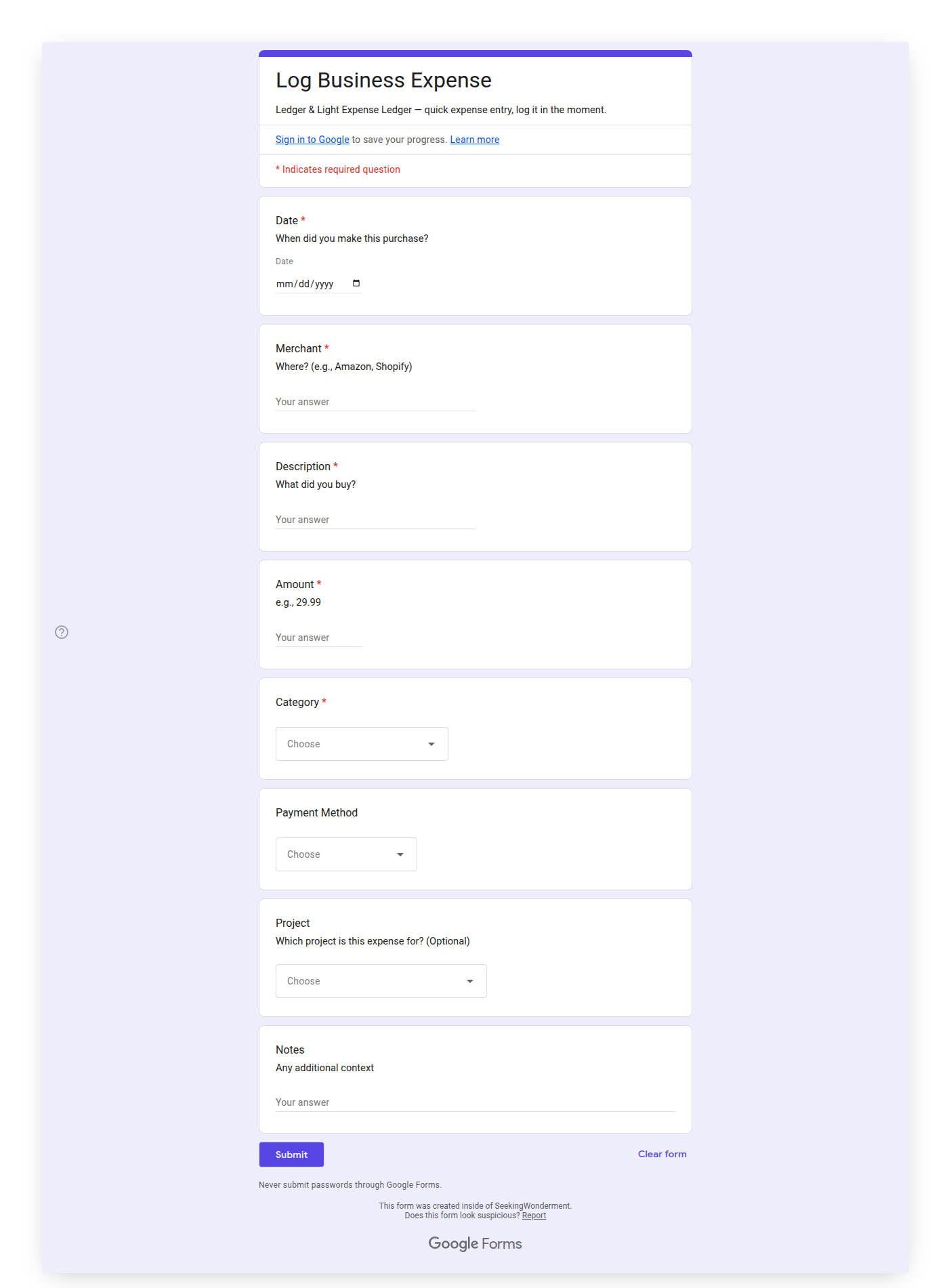
Logging an entry is a form on a phone: date, merchant, amount, category, payment method, a minute or two. The form also carries a receipt photo upload field, added once during setup because Google requires that step to be done by hand, so a photo of the electric bill can travel with the entry it belongs to.
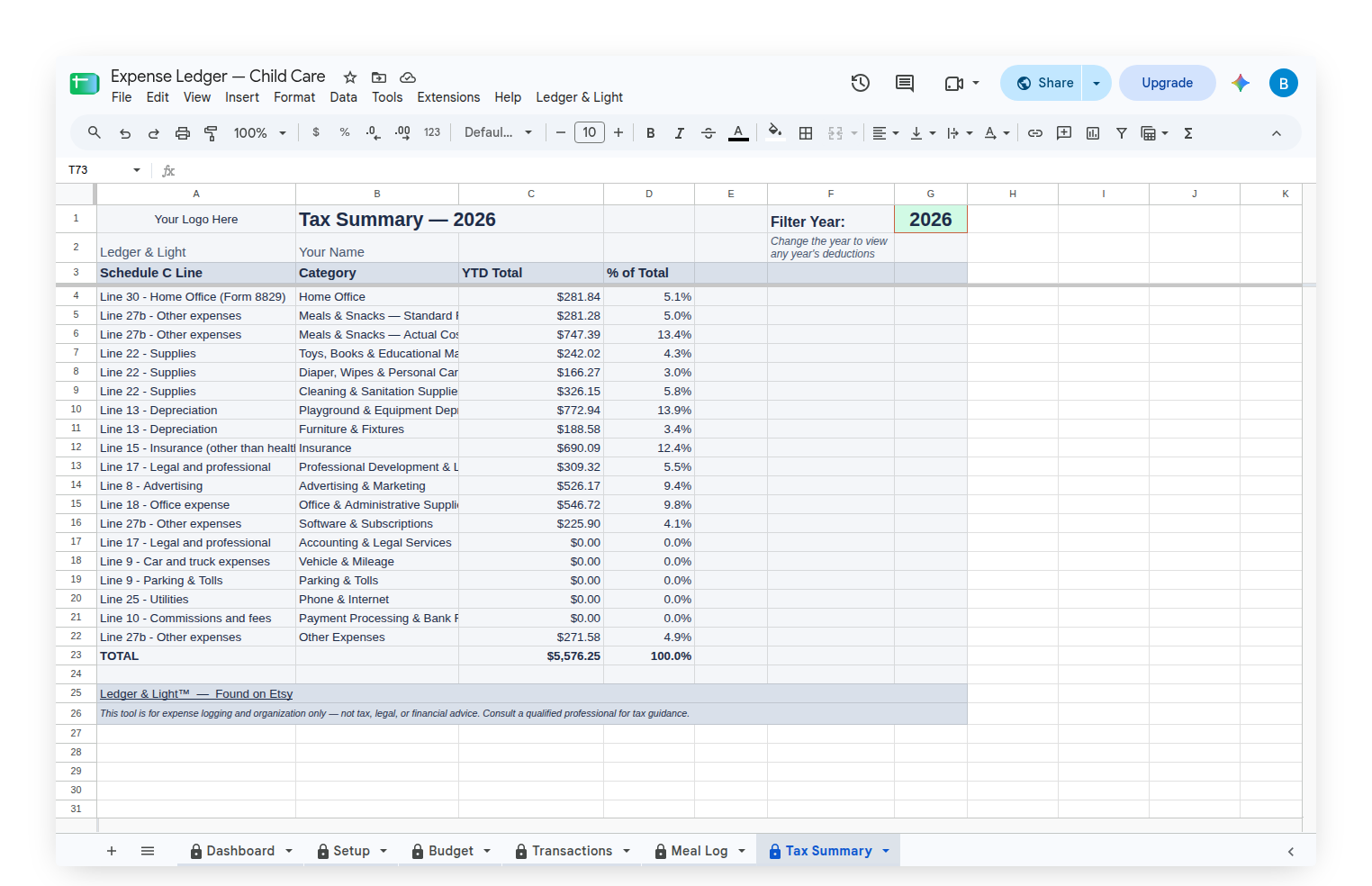
The Tax Summary tab totals every category by the Schedule C line it maps to, with a year filter for choosing which tax year to read, so the whole-home figures that the time-space percentage gets applied to are already added up when Form 8829 comes out.
What Expense Ledger does not do is calculate the time-space percentage or prepare Form 8829. That percentage comes from a provider's own square footage and her own hours record, and the form belongs on the return. The Ledger's job is to make sure the costs it applies to are complete, sorted and dated.
Handing the year to an accountant
Expense & Mileage Ledger + Reporting adds the reporting layer: Email Tax Report sends the Tax Summary, the transaction list and the mileage log as PDFs in a single email, and Tab Export saves any single tab to Drive as a PDF or PNG named by tab and year. For a provider whose accountant asks for the home-cost totals and the year's records at the same time, that is one send instead of a folder assembled by hand.
Expense Ledger holds around thirteen years of records in a single file, so there is no reason to wait for January or to start a fresh file. Every expense is entered with its own date, past dates included, and lands in the correct tax year through the year filter. It is a one-time purchase that lives in a personal Google Drive, not a subscription that has to stay paid for the records to stay readable.
This article is general information, not tax or legal advice. The time-space percentage, the licensing status that supports it, and how Form 8829 applies to a particular home and a particular child care business are all worth confirming with an accountant.