
Best Expense Categories for Event Planners
The best expense categories for event planners, what each one covers, the Schedule C line it maps to, and how a cost fronted for a client nets back out


An event is planned in reverse. The date gets held, the tents and chairs get held, the day-of crew gets booked and the florals get ordered — all of it months before anyone walks through the door. Nearly every dollar of that is deductible, and the dollars that are not deductible are the ones a client pays back, which is its own kind of good news as long as the two are told apart.
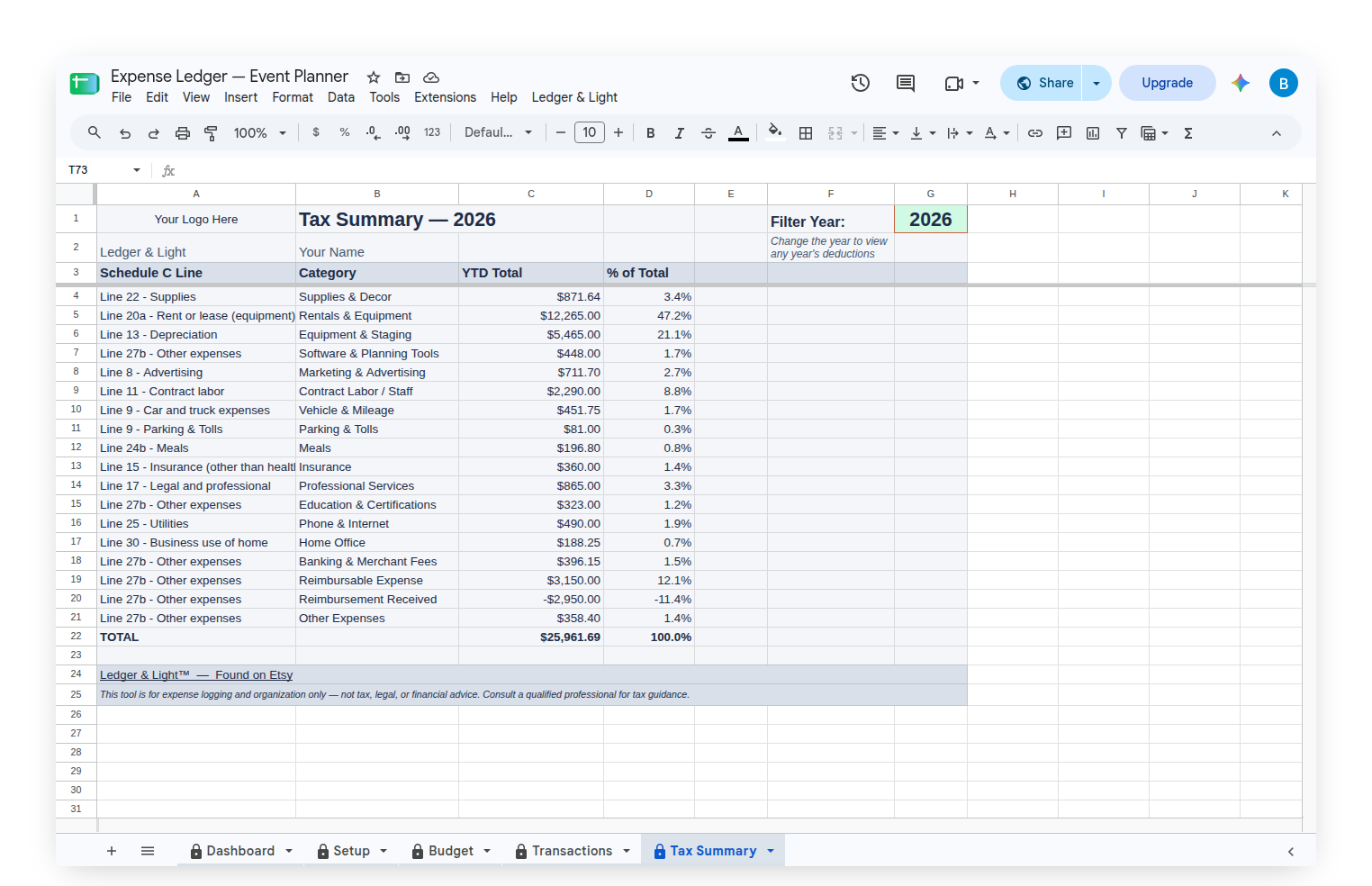
The best expense categories for event planners map directly to the IRS Schedule C lines a self-employed planner actually uses. Eighteen of them cover how an event business spends — rentals and owned staging, contract labor, decor and consumables, planning software, and the costs fronted for a client and later repaid — and each one has a clear definition, so every purchase lands in the right place from the day it is logged.
Supplies & Decor — Schedule C: Line 22 (Supplies)
The consumables that dress a room and then get used up: centerpiece materials, candles and votives, linens, ribbon, signage and easel cards, table numbers, escort and place cards, balloons and favors. Michaels, Hobby Lobby, Save On Crafts, Afloral and the bulk craft suppliers all land here. These are bought and consumed within the year, so they are deducted in the year they are bought. Small per event, substantial across a season.
Rentals & Equipment — Schedule C: Line 20a (Rent or lease, equipment)
Gear hired in for a single event and returned afterward: tents and sidewalls, tables, Chiavari chairs, linens, dance floors, staging, AV packages, uplighting, arches, lounge furniture, generators and sound systems. Because the planner never owns any of it, the cost is rent — deductible in full in the year it is paid, on the rent-or-lease line. For most planners this is one of the two or three largest numbers of the year.
Equipment & Staging — Schedule C: Line 13 (Depreciation)
The same kinds of objects, bought rather than hired: a purchased uplighting rig, owned pipe and drape, a dance floor or portable bar held in inventory, powered speakers and a PA system, modular staging risers, a laptop or an office printer. Gear that is owned lasts well beyond a single event, so its cost is recovered through depreciation rather than deducted the day it is bought. Section 179 may let a qualifying purchase be taken in full in the year of purchase — worth asking about, and worth logging here either way so an accountant can see the choice.
Rented for one night, or owned for the season
Those two categories sit next to each other on purpose, and they are the pair most worth getting right. The test is not what the object is — it is whether the planner gives it back. A dance floor hired from a rental house for a Saturday reception is Line 20a. The identical dance floor bought outright and stored in a unit is Line 13. Filing a rental invoice under the owned category moves an ordinary rent deduction onto a depreciation line and overstates the year-one write-off; filing an owned rig under rentals does the reverse.
The usual working line between a supply and a depreciable asset is around the $2,500 mark per item, under the IRS de minimis safe harbor, and the election that sets it is a return-level choice rather than a per-purchase one. Where a specific purchase falls — and whether Section 179 is the better answer than depreciating it — is a judgment call, and it belongs to a CPA. What a planner can do from the start is log the purchase in the category that describes what actually happened: hired in, or bought.
Software & Planning Tools — Schedule C: Line 27b (Other expenses)
The digital stack the business runs on: HoneyBook, Dubsado, Aisle Planner, AllSeated, Planning Pod and Social Tables, plus timeline and seating software, Canva, Google Workspace, and project tools like Asana, Monday.com or Trello. These recurring charges are easy to lose sight of precisely because they bill automatically — a named category keeps the yearly total honest.
Marketing & Advertising — Schedule C: Line 8 (Advertising)
Anything spent to bring in the next booking: The Knot, WeddingWire, Zola and WeddingPro listings, Instagram and Meta ads, Google and Pinterest ads, a styled shoot, a bridal show or expo booth, business cards, and portfolio or lead services. If it was paid to get in front of a couple or a corporate client, it belongs on Line 8.
Contract Labor / Staff — Schedule C: Line 11 (Contract labor)
The people brought in to deliver the day: day-of coordinators, assistant coordinators, event captains, setup and teardown crew, and staffing agencies. This is one of the defining lines of an event business and one the generic freelancer category set tends to miss. Pay any individual or unincorporated business $600 or more in a year and a 1099-NEC follows, so each payment is worth logging with the person's name and the event it covered.
Vehicle & Mileage — Schedule C: Line 9 (Car and truck expenses)
Every business drive in the planner's own vehicle, claimed at the IRS standard mileage rate: the venue walk-through across town, the vendor meeting, the rehearsal the night before, the supply run, the rental pickup, the early load-in on event day. The standard rate already covers fuel, maintenance, vehicle insurance and depreciation, so those costs do not also get claimed here — the miles are the deduction. For a planner working several venues a season, this is one of the largest deductions of the year and one of the easiest to under-claim, because each trip is short and none of them produces a receipt.
Parking & Tolls — Schedule C: Line 9 (Car and truck expenses)
The downtown garage during a venue walk-through, the meter at a vendor meeting, the valet or event-parking charge on a load-in day, the toll on the drive out to a country venue. These ride on the same Schedule C line as mileage but they are the one part of driving the standard rate does not absorb, which is why they get their own category and why they are claimed on top of the mileage figure rather than instead of it. A day of event parking and a bridge toll do not look like much alone; a full season of them does.
Meals — Schedule C: Line 24b (Meals)
Menu tastings with a couple and the caterer, a working lunch with a corporate client, the coffee meeting with a florist, a meal at a vendor meeting. Business meals are generally deductible at a percentage rather than in full, and the limit is applied at filing — so the full amount paid is what gets logged, along with who was there and what was discussed. Your CPA applies the limit.
Insurance — Schedule C: Line 15 (Insurance, other than health)
Business insurance premiums: general liability, event liability and special-event policies, and errors-and-omissions coverage. Next Insurance, Hiscox and Thimble are common carriers, and many venues will not release a date without a certificate. Fully deductible, and worth its own category so a monthly premium is never buried in a catch-all.
Professional Services — Schedule C: Line 17 (Legal and professional)
Fees paid to the professionals who keep the business sound: a CPA or accountant, a bookkeeper, and an attorney for a client services agreement or contract review. Tax-prep fees for the business return go here too. Keep the invoice with its date and a short note on what the service was.
Education & Certifications — Schedule C: Line 27b (Other expenses)
The training that keeps the craft current: a Certified Wedding Planner or WPIC certification, industry conferences like Engage or The Special Event, a NACE chapter event, courses, workshops, coaching and reference books. Education that maintains or sharpens the skills of the business already being run qualifies; training that prepares someone for a new line of work does not.
Phone & Internet — Schedule C: Line 25 (Utilities)
The business-use share of the phone and internet a planner runs the day on — the calls with venues, the messages with vendors, the timeline sent from a parking lot. If a line is used partly for personal reasons, the business-use percentage is the deductible share; a dedicated business line is fully deductible.
Home Office — Schedule C: Line 30 (Business use of home)
The part of the home used regularly and exclusively for the business — the desk where timelines and proposals get built, and the day-to-day operating costs around it: desk, chair, monitor, printer, ink, paper and filing supplies. Line 30 covers the square-footage allocation of rent or mortgage interest, utilities and insurance for that space. For a planner who works from home between events, this is a real deduction and a commonly overlooked one.
Banking & Merchant Fees — Schedule C: Line 27b (Other expenses)
The percentage taken out of every client payment before it lands: Stripe, Square and PayPal processing, the payment features inside HoneyBook or Dubsado, plus monthly bank charges, wire fees and deposit fees. Deposits and balances arriving online mean these accumulate quietly all year — a named category makes the annual number visible instead of invisible.
Reimbursable Expense — Schedule C: Line 27b (Other expenses)
A cost the planner pays out of the business account on behalf of a client, expecting to be repaid: a venue deposit, a catering deposit, a florist's invoice, a large rental order. The money genuinely leaves the business, so it is logged as it goes out, under its own category and never mixed in with the costs the business itself absorbs.
Reimbursement Received — Schedule C: Line 27b (Other expenses)
The money coming back the other way when the client settles up. It is logged on the same expense form as everything else, and on the Tax Summary it works as a contra line — its total is subtracted rather than added, so it nets against what was fronted.
Other Expenses — Schedule C: Line 27b (Other expenses)
The genuine leftovers that have no home above: NACE, ILEA and WIPA association dues, a business license or a special-event permit, postage on an invitation mailing, a thank-you gift for a client. Small on their own, but real deductions worth capturing rather than leaving on the table.
Fronting a client's costs, and getting the deduction right
This is the part of an event planner's return that goes wrong most often, and it goes wrong in the expensive direction. A planner who fronts a $2,000 venue deposit and is later repaid $1,800 has not spent $2,000 of the business's money. The client bore $1,800 of it. Claiming the whole $2,000 as a business expense overstates the deduction, and an overstated deduction is the kind an examiner asks about.
The two categories above are built to net against each other for exactly this reason. The fronted cost goes in under Reimbursable Expense, each repayment goes in under Reimbursement Received, and the Tax Summary subtracts the second from the first. A cost that is repaid in full nets to zero and never over-deducts. A cost that is only partly repaid leaves the unreimbursed balance — the part the business really did absorb — and that balance is the part that reaches Schedule C.
In the sample season that ships with the Ledger, $3,150 is fronted across two events and $2,950 comes back. The Tax Summary shows both, and the total deduction reflects the $200 that was never repaid. Nothing has to be worked out by hand at year end; it is the arithmetic of logging both sides as they happen.
An unreimbursed balance can be a deduction or it can be a sign that an invoice never got settled, and those are two different conversations. Logging both sides in the moment is what makes the difference visible in March instead of next April. How a specific pass-through arrangement should be treated — netted this way, or run through income and expense separately — depends on how the contract is written, and it is a question for a CPA.
The driving between the bookings
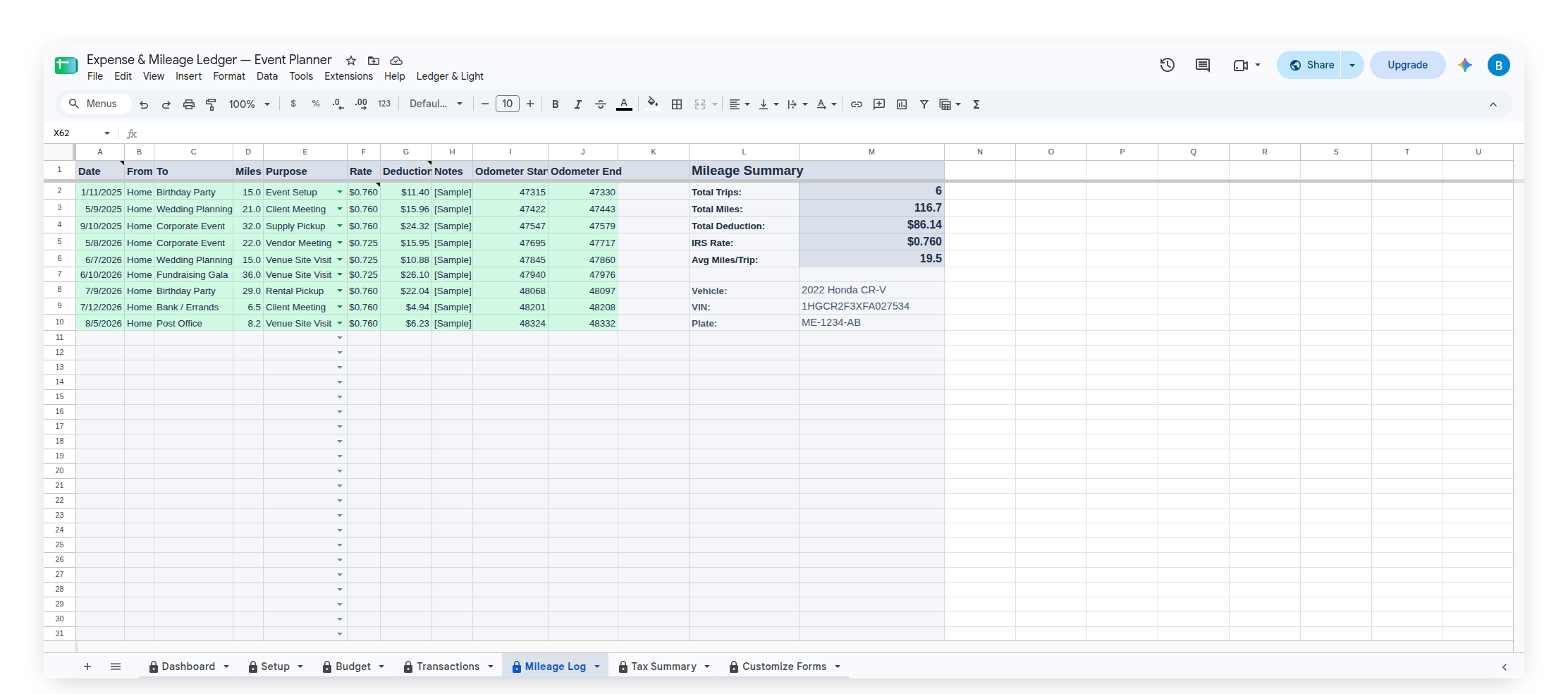
Planners drive more than they expect to. The venue walk-through across town, the tasting, the vendor meeting, the rental pickup, the rehearsal, and the load-in that starts before dawn on event day — each one is a business trip, and at the IRS standard mileage rate a season of them adds up to a meaningful deduction. They are also the easiest deduction on this list to lose, because the trips are short, frequent, and leave no paper behind.
Expense & Mileage Ledger and Expense & Mileage Ledger + Reporting add a Mileage Form and a Mileage Log for exactly this. A trip is logged from a phone when it ends — date, where it went, the business purpose, the miles — and the year's total builds itself. The trip purposes come pre-set for the work: venue site visit, client meeting, vendor meeting, supply pickup, rental pickup, event setup.
And the parking is separate. The standard mileage rate absorbs fuel, maintenance, insurance and depreciation; it does not absorb the garage, the meter, the valet charge or the toll. Those are logged as expenses under Parking & Tolls and claimed on top of the mileage deduction, not instead of it.
Categories already built for the work
Expense Ledger arrives with the event-planner categories already built — the eighteen above, in the Expense Form's dropdown, each mapped to the Schedule C line it belongs to. There is no category list to configure. A cost is logged from a phone in a minute or two: the vendor, the amount, the category, a short note, and a receipt photo if the receipt is in hand. That photo question is the one put on the form by hand, following the setup instructions, because Google gives the setup script no way to create it. The Transactions tab accumulates the season, and the Tax Summary tab shows a running total for every Schedule C line, organized the way a return is organized.
It is a one-time purchase with no subscription, it lives in a personal Google Drive, and a single file holds around thirteen years of records. Every entry carries its own date — past dates included — so a planner can start in the middle of a wedding season and each cost still lands in the right tax year.
For the year-end handoff, Expense & Mileage Ledger + Reporting adds Email Tax Report, which sends an accountant the Tax Summary, the full transaction list and the year's mileage log as PDFs in a single email, plus Tab Export, which saves any individual tab to Drive as a PDF or PNG, auto-named by year. Want to hand your accountant everything in one send? That is what the Expense & Mileage Ledger + Reporting does.
Log the cost when the money goes out, pick the category, note which event it was for, and log the repayment when it lands. Do that through a season and the return is already written: the rentals on their line and the owned rig on its own, the crew on contract labor, the decor in supplies, the miles totalled, and only the money the business truly absorbed reaching the deduction.