
Landlord Tax Deductions: A Rental Property's Year on Schedule E
Landlord tax deductions on Schedule E, grouped by when each cost actually lands — monthly, between tenants, once a year — and kept per property


A long-term rental is one of the steadier businesses to keep books for, and that steadiness is exactly what keeps landlord tax deductions organized. The mortgage statement arrives on the same day every month. The lawn gets cut on a schedule. The county sends its bill at the same point every year. Once you know which of those costs Schedule E is already waiting for, and each one is logged against the property it belongs to as it happens, filing stops being an excavation and becomes a read.
Rent from a residential lease is passive rental income, and it belongs on Schedule E, Supplemental Income and Loss — not the Schedule C a self-employed business files. The dividing line is service: providing a property and keeping it maintained sits on Schedule E, while providing substantial services to the people staying there points somewhere else. Where any particular arrangement lands is a call for your CPA. Either way, the return is built property by property, each one carrying its own rent and its own column of costs.
The costs that arrive every month
These are the ones a calendar could log for you. They are also the largest, which makes them the worst ones to reconstruct in April.
Mortgage interest — Line 12. The interest portion of the loan on the rental, which the lender totals for you on Form 1098 in January. Only the interest is deductible here; the principal is not a deduction at all.
Management fees — Line 11. What a property manager or management company keeps, plus a leasing or tenant-placement fee when they fill a vacancy.
Utilities — Line 17. Water, sewer, trash, and any electric or gas the lease leaves in your name — including common-area service on a multi-unit building.
Cleaning and maintenance — Line 7. The recurring upkeep that has nothing to do with anything breaking: lawn care, landscaping, snow removal, pest control, gutters, the seasonal HVAC filter.
The costs of turning a unit over
A tenancy ending is the busiest week of a landlord's year, and it is where receipts scatter fastest. Four categories carry almost all of it.
Advertising — Line 5. Listing the unit: Zillow, Apartments.com, a rental listing service, a yard sign, a boosted local post.
Repairs — Line 14. Putting right what wore out or broke — a plumber, an appliance repair, a water heater, a drywall patch, a re-key. A repair keeps the property in the condition it was in; a betterment that upgrades or extends it is an improvement, which is capitalized instead. That line is worth asking your CPA about on anything large.
Supplies — Line 15. The hardware-store run behind the turnover: filters, light bulbs, smoke-detector batteries, paint, cleaning supplies, small tools.
The costs that come once a year
Annual bills are the easiest to log and the easiest to forget, because there is no monthly rhythm reminding you they exist.
Taxes and licenses — Line 16. County or municipal property tax, plus rental registration, a rental permit, or a local business license where your city requires one.
Insurance — Line 9. The landlord or dwelling policy on the property, and an umbrella policy carried over it.
Legal and professional fees — Line 10. Your CPA, a bookkeeper, an attorney, lease drafting, an eviction filing.
Other — Line 19. The line for the costs that fit nowhere above: HOA dues, bank fees, software and subscriptions you run the rental on.
What a vacancy does, and does not do, to the return
This one surprises new landlords, so it is worth stating plainly. Rent you did not collect during a vacant month is not a deduction — you never counted it as income, so there is nothing to subtract. What you can keep deducting is the ordinary cost of holding the property, as long as it stays available to rent: the mortgage interest still accrues, the lawn still gets cut, the insurance still runs, and all of it stays on Schedule E while the unit is listed and ready. A vacancy is a gap in income, not a gap in deductions. The one case that works differently is a property being readied for its very first rental, before it has ever been available — those pre-service costs are capitalized rather than deducted, which is a different story with its own rules.
Depreciation, and the date it starts from
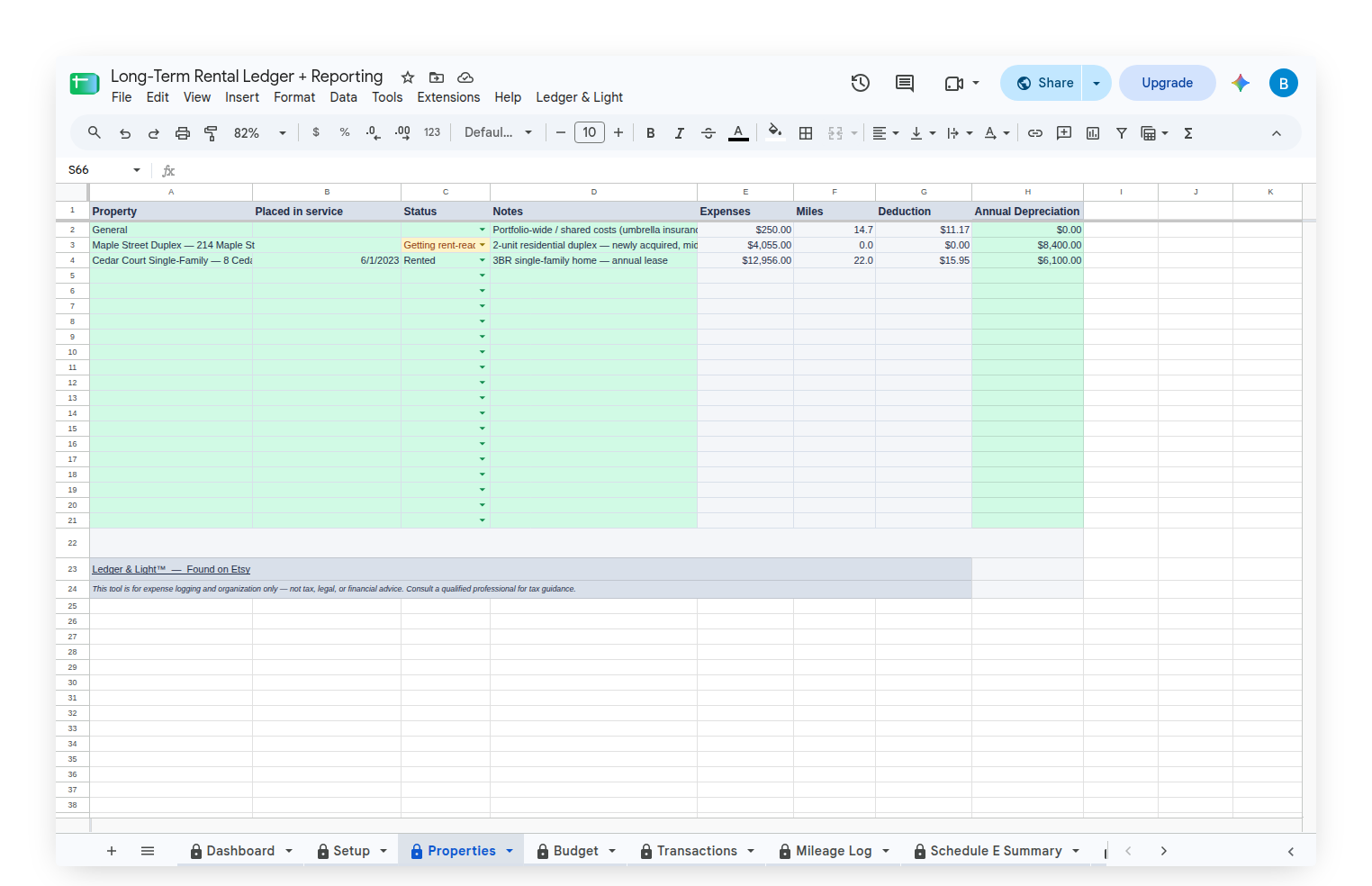
Depreciation is the deduction that runs quietly underneath all the others: the tax code lets you recover the cost of the building itself a slice at a time, and residential rental property is written down over 27.5 years. It is often a landlord's single largest annual deduction, and it is the one most often left unclaimed. The figure for a given year comes from your basis and the date the property was placed in service, and it is a number your accountant calculates — never one a ledger should guess. What a ledger can do is give it a home: an annual, per-property input that carries the accountant's figure to Line 18 and rolls it into that property's summary.
The driving a landlord actually does
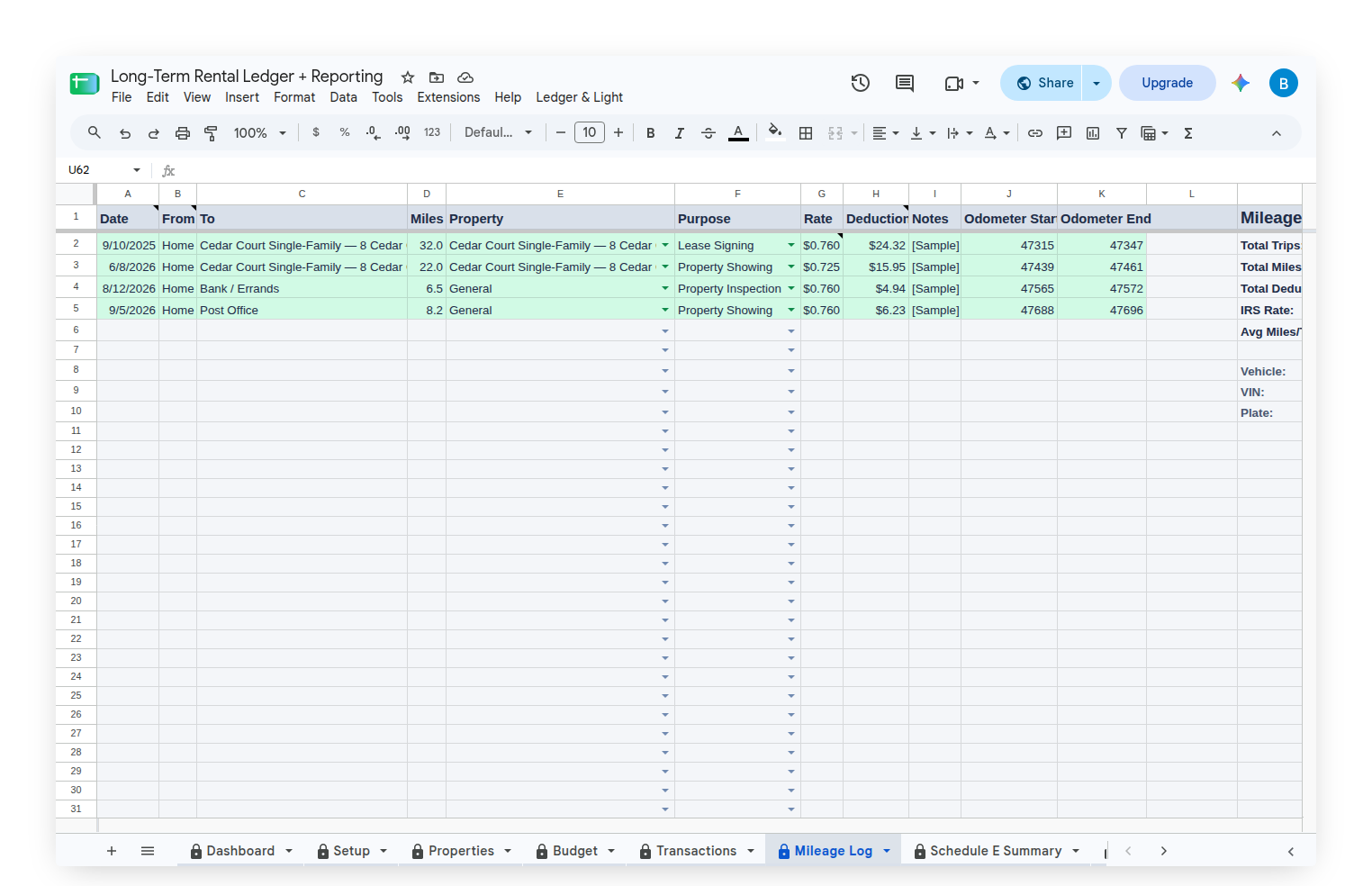
Showing a unit, meeting a contractor, the run to the hardware store, the drive from one of your properties to another, the trip to the county office to renew a registration — these are the ordinary local transportation costs of collecting rent and managing, conserving or maintaining a rental, and they are deductible under Auto and travel on Line 6 at the IRS standard mileage rate. Logged trip by trip with the date and the property, a year of small drives becomes a deduction worth having.
One condition comes before all of that, and it is the one most landlords have never been told. Driving between your home and a rental property is generally not deductible — the IRS treats it as commuting — unless you use your home as your principal place of business. That is Publication 527's own wording, and it is why the quarterly drive out to check on the place is not automatically a deduction: whether it counts turns on where your rental business is actually run from, which is a Publication 587 question and a conversation with your accountant. Log every trip regardless. The log is what lets your CPA decide which ones you can claim; a trip you never wrote down cannot be claimed even when it qualifies.
A second rule applies to travel away from home — the overnight run to a property in another state. You cannot deduct that travel if the primary purpose of the trip is to improve the property; the cost of the improvement itself is recovered through depreciation instead. Keep the improvement trips marked so your accountant can sort them from the ordinary ones.
One property per column, all year
The Long-Term Rental Ledger is built the way Schedule E is built: every entry belongs to a property. You open a mobile Expense Form, fill in the merchant, amount, and category, choose which property the cost is for, and submit. The entry lands in your sheet already sorted by property and mapped to its Schedule E line. A receipt photo field goes onto that form by hand, because Google gives the setup script no way to create one, and the setup instructions walk through adding it. From then on you can snap a photo of the receipt and attach it in the same pass. A single entry takes a minute or two, at the moment the money goes out.
Each property then gets its own Schedule E Summary — its categories, its per-line totals, its deduction total — standing apart from every other property you own. Nothing has to be filtered or split out later, because it was never mixed.
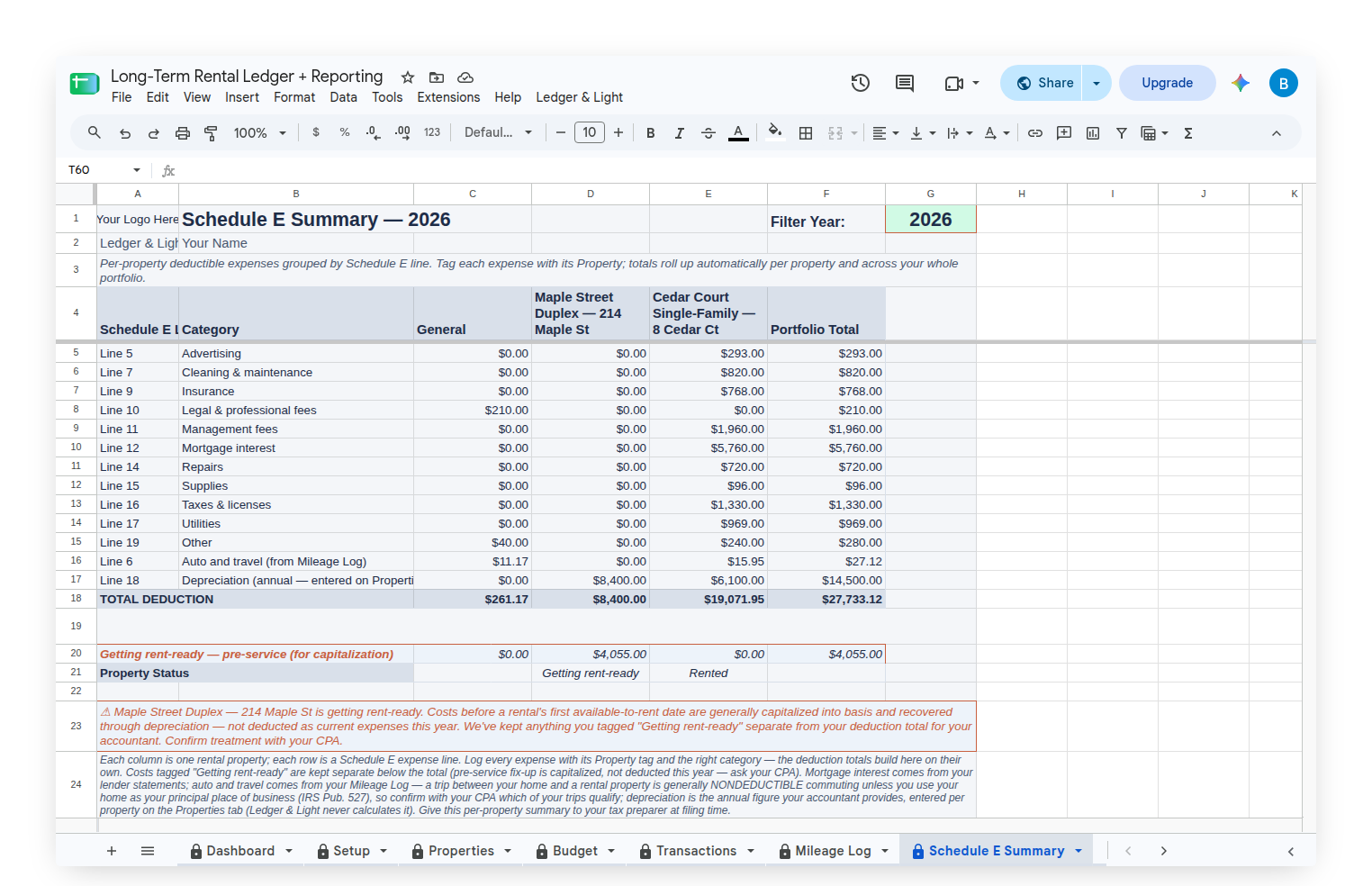
If you drive for the rentals, the Long-Term Rental Ledger + Mileage adds a Mileage Form and a Mileage Log, with each trip logged against its property so the miles sort the way the costs do. And the Long-Term Rental Ledger + Reporting adds a Properties tab holding each property's status, its placed-in-service date, and the annual depreciation figure from your accountant, plus Email Schedule E Report — which sends your per-property summary to your accountant as a formatted PDF — and Tab Export, which saves any tab to your Drive as a PDF or PNG, auto-named by year.
One purchase, yours to keep; there is no subscription. A single file holds around thirteen years of records, and every entry carries its own date — a past one included — so you can start partway through a year and each cost still lands in the tax year it belongs to.
The habit that makes a landlord's April short
Log each cost against its property the day it happens, and log every trip whether or not you are sure it qualifies. Let the annual bills land in their own categories instead of a mental note. Keep the improvement spending marked so your accountant can capitalize what belongs in basis. Enter the depreciation figure once a year when your CPA gives it to you. Do that, and Schedule E is a form you copy numbers onto rather than one you research. Your accountant has the final word on how any particular cost is treated.
You can find the Long-Term Rental Ledger in the Ledger & Light shop on Etsy.
See all Ledger & Light products →