
Is Your Driving Deductible? A Mileage Guide for Makers and Etsy Sellers
The mileage deduction for Etsy sellers, which shop drives count, how the home office turns a commute into a business mile, and how to log it so it holds

Here is the good news most shop owners never hear: the mileage deduction for Etsy sellers comes down to a single, knowable rule, and for a maker who works from a home studio, most of the year's driving can count. Every mile driven for the shop lands in one of two buckets. One is deductible. One is not. Once it's clear which trip is which, the guessing stops — and so does leaving real deductions unclaimed.
The one rule that decides
A trip is a business mile when its purpose is business and it runs between two work points. A trip is a commute when it carries a person between home and a regular place of business. The distinction is not the vehicle, the distance, or the time of day. It is the purpose of the drive and where the business is based.
That second part — where the business is based — is the hinge the rest of this turns on.
The drives a Maker business actually makes
Running a handmade, print-on-demand, or craft shop puts real miles on the odometer, and most of them are business miles:
- Post office and shipping runs — dropping orders at USPS, UPS, or a FedEx depot
- Supply runs — a trip to Michaels, Joann, Hobby Lobby, or a hardware store for materials
- Materials pickup — collecting a bulk order, blanks, or a special-order component
- Craft fair and market trips — driving to a booth at an artisan market, holiday show, or pop-up
- Wholesale deliveries — dropping a line order with a stockist or local retailer
- Photo shoots — driving to a location to photograph products for listings
The common thread is that each trip has a business purpose and connects to the work itself, not to the simple fact of getting from home to a fixed workplace.
What the IRS treats as a commute
Driving from home to a regular or main place of business is a personal commute, and it is never deductible — no matter how far or how early. If a maker rents a separate studio or a market stall they report to daily, the drive from the house to that location is the classic non-deductible commute. Commuting miles still have a place in the records: Schedule C asks for them even though they do not reduce the tax. So the miles get counted. They just do not get deducted.
The home-office rule that changes everything
This is the biggest lever for a home-based shop, and the one that quietly rewrites the whole calculation. If a home studio qualifies as the principal place of business, there is no non-deductible commute at all. The trip from the home studio to the post office, to the supply store, or to a craft fair is a business mile from the moment the car backs out of the driveway.
Consider what that means over a year. For a maker who designs, produces, packs, and ships from home, nearly every shop-related drive can count — door to door — instead of only the leg between two outside stops. For a lot of solo sellers, the home studio is the difference between a handful of deductible trips and almost the whole year of driving.
The condition is that the home studio has to genuinely qualify as the principal place of business under the IRS rules — regular and exclusive use for the business. That is worth confirming with an accountant before relying on it.
Temporary work locations
There is one more useful exception. A trip to a temporary work location — a job realistically expected to last a year or less — can be deductible even when it starts from home. A weekend craft fair across the state and a one-day product photo shoot are temporary work locations, not commutes to a fixed workplace. The rules carry conditions worth checking with an accountant, but the principle is that short-term destinations are treated differently from a permanent place of business.
What the miles are worth
For 2026 the IRS standard mileage rate is 76 cents a mile. Because the IRS adjusted the rate partway through the year, trips taken from January through June 2026 calculate at 72.5 cents a mile and trips from July through December at 76 cents — the Mileage Log applies the right figure to each trip by its date, so the math is handled without any manual sorting. At those rates, a maker who drives to the post office twice a week, restocks supplies monthly, and works a season of markets can reach a meaningful deduction on the driving alone.
Logging it so the deduction holds
Knowing the rule is half of it. The other half is a record the IRS will accept, which means logging each trip with its purpose at the time it is taken, not reconstructing it in April. Mileage Ledger is built for exactly that. The Mileage Form opens on a phone in any mobile browser, with no app to download, so a trip gets logged in the moment before pulling out of the lot. The Purpose field carries the drives a shop actually makes — a post-office run, a supply run, a craft fair, a wholesale delivery — and every trip is entered with its own date, past dates included, so a maker can start at any point in the year and each trip lands in the right tax year.

For a personal drive or a true commute, the Purpose field has a Commute option. Choosing it zeros the deduction while still totaling the commuting miles Schedule C asks for, so the line gets filled in without inflating the deduction.
The Mileage Log does the math
Each business trip lands in the Mileage Log with the deduction calculated per trip at the current IRS standard mileage rate. Set a qualifying home studio as the base once, and every trip logs from the driveway forward as business.
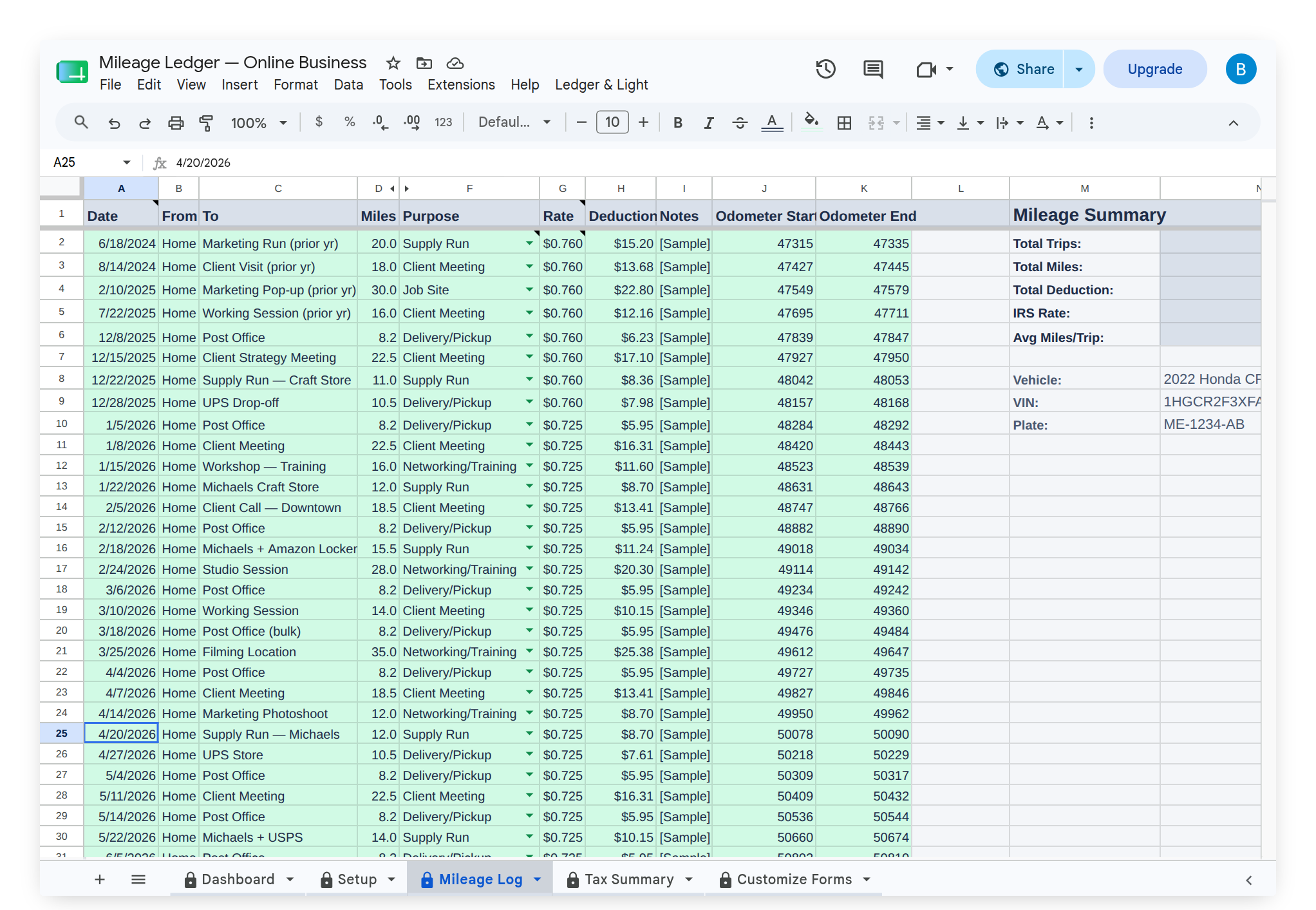
Mileage Ledger is a one-time purchase that lives in a personal Google Drive — no subscription — and holds many years of trips in a single file. The log built this year works the same in year five, and the records belong to the driver, not to a plan that has to be renewed to keep access.
For the year-end handoff, Expense & Mileage Ledger + Reporting adds Email Mileage Log Report, which sends the full mileage log to an accountant as a formatted PDF, and Tab Export, which saves any tab to Drive as a PDF — so the classifications kept all year arrive ready to file.
This article is general information, not tax or legal advice. The rules around commuting, home offices, and temporary work locations carry conditions specific to each situation, so an accountant has the final word on what is deductible.