
Schedule E Deductions for Short-Term Rental Hosts
A plain-language guide to Schedule E deductions for short-term rental hosts, from cleaning to depreciation, kept per property and ready for your CPA


Schedule E deductions for short-term rental hosts come down to one steady idea: nearly every dollar it takes to run a rental property is money the tax code lets you set against that property's rental income. If you host on Airbnb, VRBO, or take direct bookings, you already spend on the things that keep a place guest-ready all year. Knowing which of those costs land on Schedule E, and keeping them sorted the way the form expects, turns tax season into reading numbers that are already in order.
Short-term rental income that you report as a passive rental activity goes on Schedule E, Supplemental Income and Loss. It is a different form from the Schedule C that self-employed businesses use, and the distinction matters: Schedule E is built around each property standing on its own, with its own income and its own column of expenses. Whether one property is right for your situation, or whether the level of service you provide points somewhere else, is a call for your CPA. What every host can do in the meantime is keep clean, per-property records so that conversation is short.
The expenses that show up on Schedule E
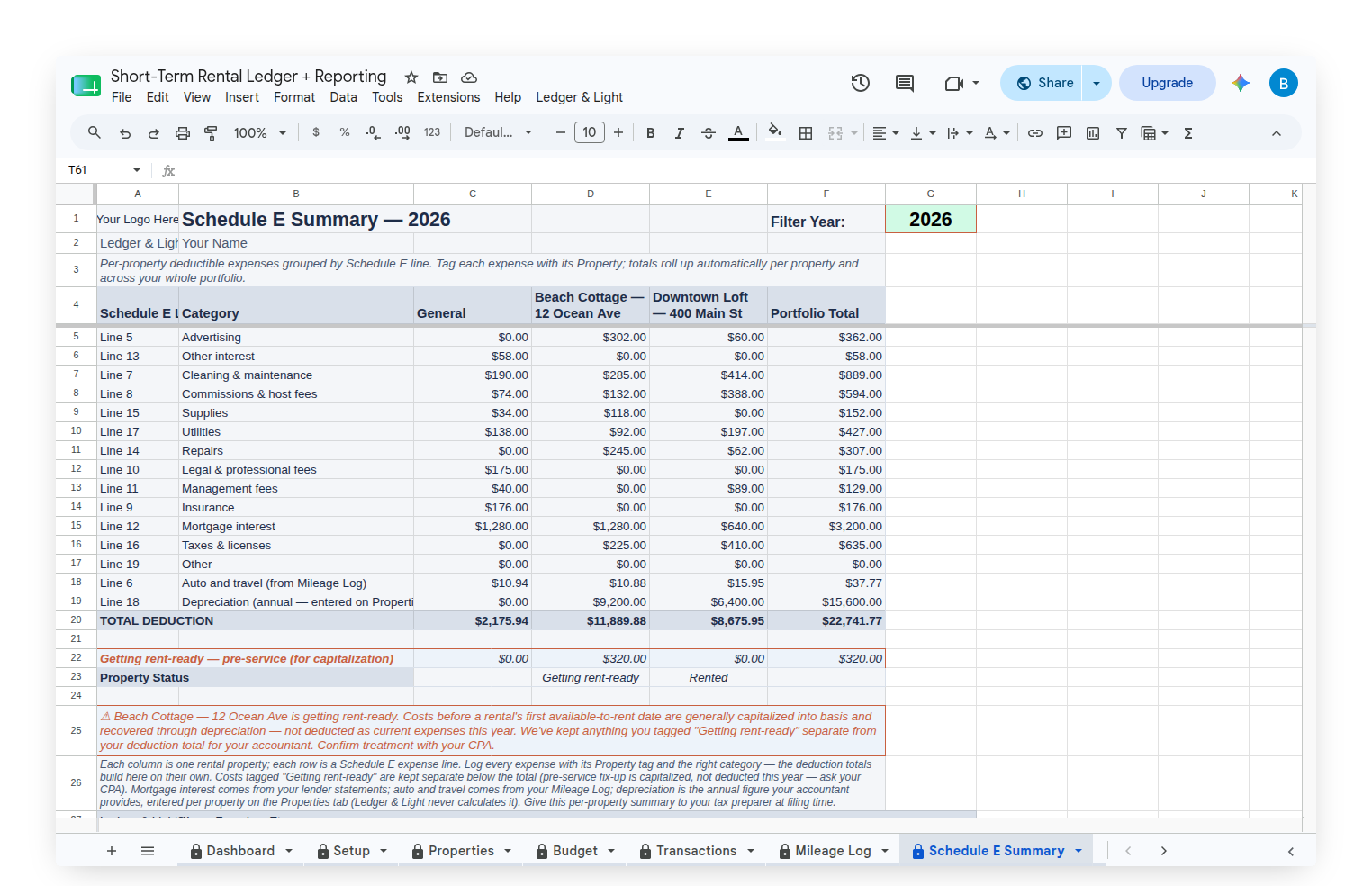
Schedule E gives each cost a home, and a short-term rental's spending maps onto its lines almost one for one. Here is the whole set, in the order the form reads them.
Advertising — Line 5. Listing photography, a promoted placement, a booking site's visibility boost, an ad pointing guests at a direct-booking page.
Auto and travel — Line 6. The turnover run, the hardware-store trip, the drive out to meet a cleaner. There is more on this further down.
Cleaning and maintenance — Line 7. Turnover cleans between guests, laundry and linen service, landscaping, pool or hot-tub service, pest control, snow removal.
Commissions and host fees — Line 8. What the platform keeps: an Airbnb host service fee, a VRBO commission, a Booking.com charge, a co-host's cut of a stay.
Insurance — Line 9. The short-term rental or landlord policy on the property, host protection coverage, an umbrella policy.
Legal and professional fees — Line 10. A CPA, a bookkeeper, an attorney, tax prep, a permit filing someone handles for you.
Management fees — Line 11. A property manager's cut, and the tools doing a manager's work: channel managers, dynamic-pricing services, guest-messaging automation.
Mortgage interest — Line 12. The interest portion of the loan on the rental, as the lender reports it on Form 1098.
Other interest — Line 13. Interest on borrowing that is not the mortgage: a HELOC drawn for the property, a card carried for rental costs, a private loan.
Repairs — Line 14. Fixing what breaks — a plumber for a clogged sink, an appliance repair, a handyman, a locksmith, a patched wall.
Supplies — Line 15. Toiletries, coffee, paper goods, linens, the welcome-basket restock.
Taxes and licenses — Line 16. Property tax, occupancy or lodging tax, the short-term rental permit, the local business license.
Utilities — Line 17. Electricity, water, gas, trash, and the internet and streaming the guests use.
Depreciation — Line 18. The yearly write-down of the building and its big-ticket furnishings — an annual figure rather than a receipt you log, which is why it gets its own explanation below.
Other — Line 19. Where the leftovers go: HOA dues, bank fees, dues and subscriptions, anything with no home above.
The point is not to memorize line numbers. It is to log a cost against the right category once, so the total is waiting on the right Schedule E line when you file.
Depreciation is an input, not a mystery
Depreciation is the tax code's way of letting you recover the cost of the building itself, and of furniture and appliances, a slice at a time over their useful life rather than all at once. It is a real, sizable deduction, and it is the one hosts most often leave on the table. The amount for a given year is a figure your CPA calculates from your basis and placed-in-service date. Once you have that number, it belongs on Line 18. A good ledger gives depreciation its own annual, per-property input and carries it to Line 18 for you — you enter the figure your accountant provides, and it lands in the summary. The ledger never guesses the number; that stays your CPA's call.
Mileage counts too
If you drive for your rentals — the turnover run, the trip to the hardware store, the drive out to meet a cleaner, the hop from one of your properties to another — those miles are deductible under Auto and travel on Line 6, at the IRS standard mileage rate. Logged trip by trip, with the date and the property, they add up to a deduction worth having by year-end. Logging them in the sheet takes a Mileage Log, which the Short-Term Rental Ledger + Mileage adds.
One condition rides along with all of it, and most hosts have never been told it: driving between your home and a rental property is generally not deductible — the IRS treats it as commuting — unless you use your home as your principal place of business. That is Publication 527's own wording. Trips between your properties, and driving to collect rent or to manage, conserve or maintain a rental, are the ordinary deductible ones. Log every trip either way: the log is what lets your accountant decide which ones you can claim, and a trip you never wrote down cannot be claimed even when it qualifies.
Keep it per property, all year
The reason to log as you go is simple: reconstructing a year of rental costs from bank statements in April is slow, and it is where deductions quietly go missing. The Short-Term Rental Ledger is built for the way hosts actually spend. You open a mobile Expense Form, fill it in when the money goes out, choose which property it belongs to, and the entry lands in your sheet on its own — sorted by property and mapped to its Schedule E line. A receipt photo field goes onto that form by hand, because Google gives the setup script no way to create one, and the setup instructions walk through adding it. From then on you can snap a photo and attach it when you have the receipt in hand. Each property gets its own Schedule E Summary, so at any point in the year you can see where a given property stands.
If you also drive for your rentals, the Short-Term Rental Ledger + Mileage adds a Mileage Form and Mileage Log that carry your property miles to Auto and travel (Line 6) at the standard rate. And when you want to hand your accountant a finished packet, the Short-Term Rental Ledger + Reporting adds a Properties tab that holds each property's status, placed-in-service date, and annual depreciation input, plus Email Schedule E Report — which sends your per-property Schedule E summary to your accountant as a formatted PDF — and Tab Export, which saves any tab to your Drive as a PDF or PNG, auto-named by year. One purchase, yours to keep; there is no subscription. A single file holds around thirteen years of records, every entry carrying its own date — including a past one — so a host can start in the middle of a year and each cost still lands in the tax year it belongs to.
The habit that makes it work
Log each cost when it happens, against the property it belongs to. Keep the pre-service make-ready costs tagged and set aside for your accountant. Enter the depreciation figure your CPA gives you on the Properties tab. Do that through the year, and your Schedule E deductions are not something you assemble at tax time — they are something you simply read. Confirm the treatment of any specific cost with your CPA; the ledger keeps the record, your accountant has the final word.
You can find the Short-Term Rental Ledger in the Ledger & Light shop on Etsy.
See all Ledger & Light products →