
What 'Placed in Service' Means for Your Rental, and Why Make-Ready Costs Are Different
What placed in service means for a rental property, why pre-service make-ready costs are treated differently, and how to keep them separated for your CPA


There is a single date that quietly shapes how a rental property's early costs are treated on your taxes, and it has a name: the day the property is placed in service. For a placed in service rental property, that is generally the first day it is ready and available to rent — listed, furnished, and open for bookings — not the day you bought it, and not the day the first guest arrives. Understanding that date is one of the friendliest things a host can do for their future self, because it draws a clean line between two kinds of spending that the tax code handles very differently.
Before the line, and after it
Once a property is placed in service, the ordinary costs of running it — cleaning, supplies, utilities, repairs, insurance, the host fees — are current-year expenses you deduct on Schedule E, the year you spend them. That is the familiar rhythm most of this guide's companion articles describe.
The costs you spend getting a property ready to rent for the first time live on the other side of that line. Repainting before the first guest, the deep clean, the new mattresses and linens, fixing up the bathroom, the furniture that makes it a rental — these are your make-ready or pre-service costs. They are real money and they are not lost. But because they happen before the property is available to rent, they are generally capitalized into the property's basis and recovered through depreciation over years, rather than deducted all at once in the year you spend them. Big-ticket furnishings follow their own depreciation schedule. Carrying costs like mortgage interest and property tax during the fix-up period are handled separately again. The exact treatment of any given cost — and whether a start-up election applies to your situation — is genuinely your CPA's call. What matters for you as a host is simply noticing which costs came before the property was rent-ready, and keeping them separate so your accountant can decide.
Why separating them protects you
If make-ready costs get folded into the current-year deduction pile, two things can go wrong: the current-year deduction looks larger than it should, and the depreciation you are entitled to over time is harder to reconstruct later. Keeping pre-service costs set aside is not about deducting less — it is about deducting correctly, and being able to show your accountant a clean picture. Money tagged for capitalization is money recovered the right way, just spread out.
How the ledger keeps the line for you
This is exactly what the Short-Term Rental Ledger is built for. When you log a cost that belongs to getting a property rent-ready, you tag it Getting rent-ready. Tagged costs are kept separate from that property's current-year deduction total — they show on their own pre-service line in the Schedule E summary, clearly marked as capitalize candidates for your accountant, and out of the running deduction total so nothing is overstated. The ledger does not decide the tax treatment; it segregates what you label so your CPA can.
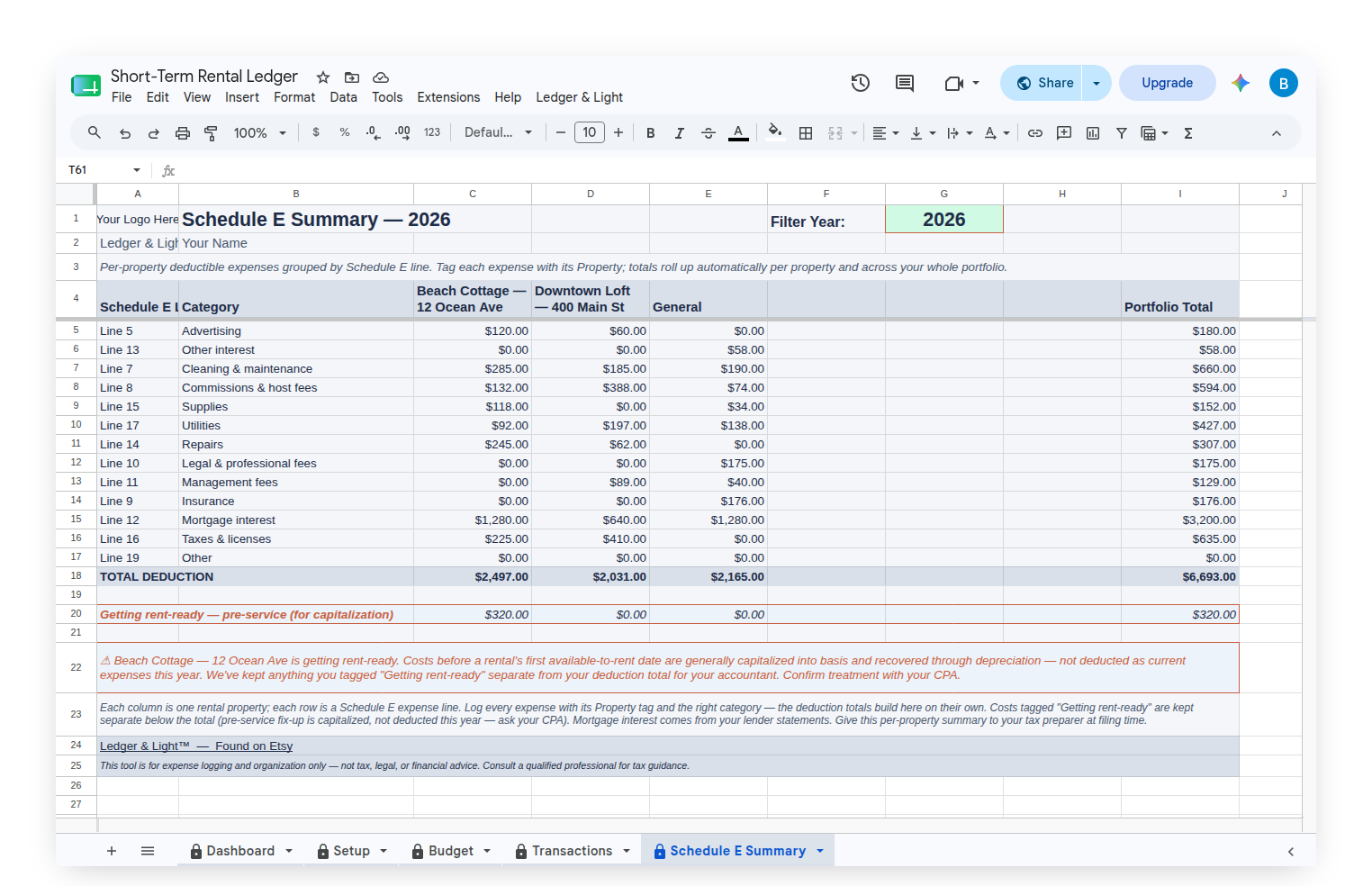
When a property is genuinely getting ready, a gentle callout appears to remind you what the tag means:
Costs before a rental's first available-to-rent date are generally capitalized into basis and recovered through depreciation, not deducted as current expenses this year. Anything you tagged "Getting rent-ready" is kept separate from your deduction total for your accountant. Confirm treatment with your CPA.
The date has a home, too
On the Short-Term Rental Ledger + Reporting, each property gets a Properties tab that holds its placed-in-service date, its current status — Getting rent-ready, Listed, Rented, Under repair, Vacant, or Sold — and the annual depreciation input your CPA provides, which the ledger carries to Line 18. Recording the placed-in-service date the moment a property goes live means the single most important date in this whole story is written down while it is fresh, not reconstructed a year later. The Properties tab is also what lets Email Schedule E Report send your accountant a per-property summary — status, deductions, and the pre-service line all in one formatted PDF — and Tab Export save any tab to your Drive, auto-named by year. It is a one-time purchase with no subscription, and one file carries a property from its make-ready year through the years it earns.
The habit
When you take on a property, note the day it becomes available to rent — that is your placed-in-service date. Until then, tag the fix-up spending "Getting rent-ready" as you log it. After it goes live, log the running costs the normal way. Do that, and the line between capitalized and current stays clear all year, and your accountant gets a record that already knows the difference. As always, the ledger keeps the record; your CPA has the final word on how each cost is treated.
The Short-Term Rental Ledger is in the Ledger & Light shop on Etsy.
See all Ledger & Light products →