
Why a Bed and Breakfast Files Schedule C, and Where Each Cost Belongs
Bed and breakfast tax deductions explained — why an inn files Schedule C, why breakfast is cost of goods sold, and how to split a house that is also a home


An inn is one of the few businesses whose product is a morning. Guests remember the coffee, the light in the dining room, the fact that somebody had already thought about the towels. Every one of those small acts of hospitality costs money, and nearly all of it is deductible — which means bed and breakfast tax deductions come down to noticing what you already spend and putting it somewhere the return can find it.
Why an inn files Schedule C, not Schedule E
This is the first fork in the road, and it decides everything downstream. A passive landlord — someone who rents space and maintains it — reports on Schedule E. An innkeeper does something categorically different: breakfast every morning, rooms serviced during a stay, check-in, local advice, sometimes an evening pour. The IRS calls that substantial services, and providing it makes the property an active trade or business, reported on Schedule C.
Two consequences follow. The first is that the deduction map is the Schedule C one, with its own line numbers and its own Part III for cost of goods sold. The second is less pleasant but better known early: profit from an active trade or business is subject to self-employment tax in addition to income tax, which a passive rental's profit generally is not. Where a specific operation falls on the service spectrum is a judgment call, and it is your CPA's to make — but a working bed and breakfast serving breakfast daily is squarely on the Schedule C side.
The house is a home and a business, and the line between them matters
Most innkeepers live where they work, and that makes one question unavoidable: how much of the house is the business? The portion used exclusively for the inn — guest rooms, guest baths, the dining room where breakfast is served — is business space, and costs belonging to it are business costs. Your own quarters are not. Whole-house costs that serve both, like the electric bill or a new roof, get allocated between the two, usually by rooms or by square footage.
None of that is a reason to log less. It is a reason to log everything with enough detail that your accountant can apply the split cleanly at year end, rather than reconstructing which repair was upstairs in your apartment and which was in the guest wing. Note what a cost was for; let your CPA set the method.
What the guest consumes
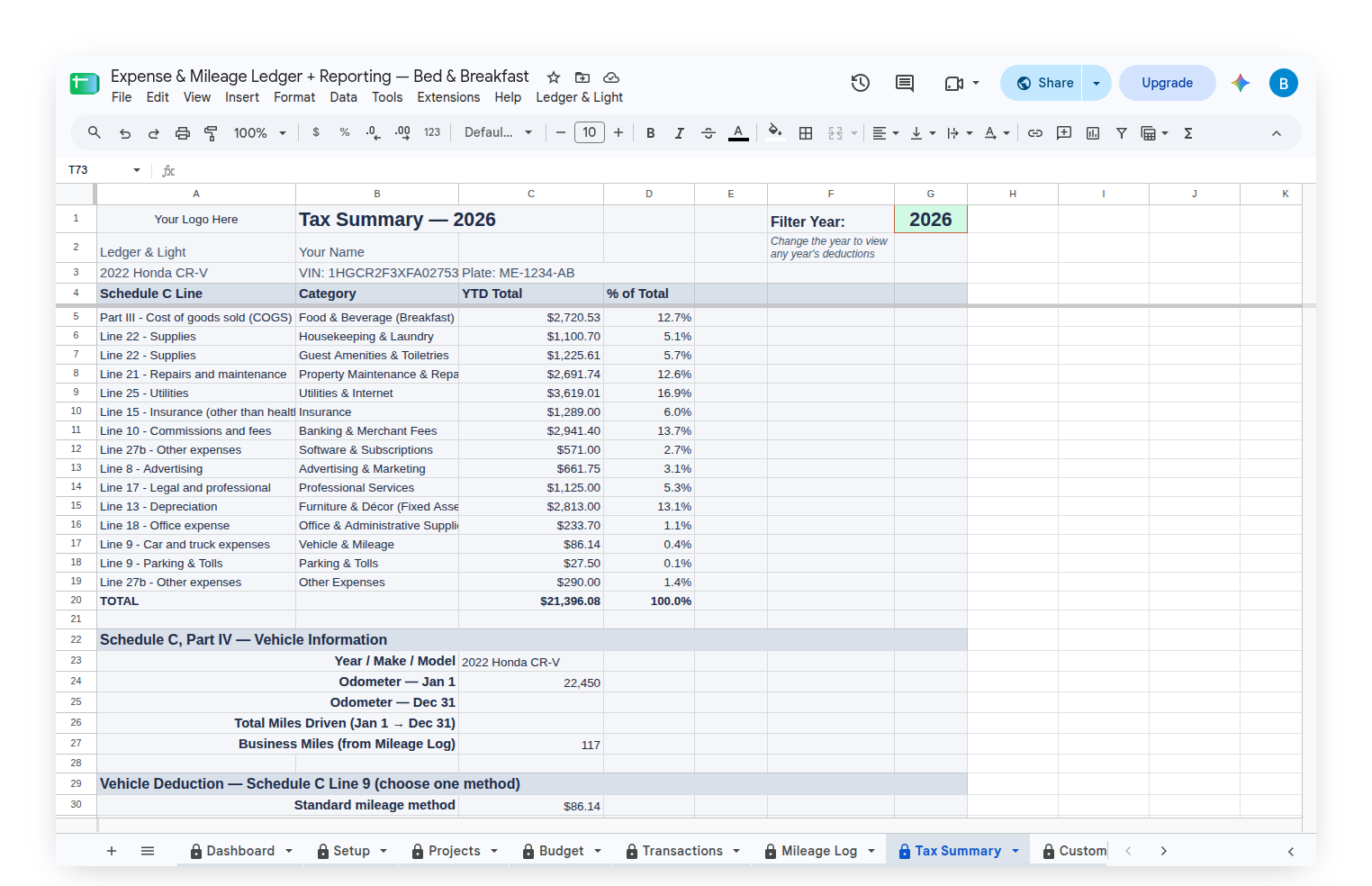
Food & Beverage (Breakfast) — Part III, cost of goods sold. The eggs, the bakery order, the coffee beans, the juice, the butter and cream. Food served to guests is the one cost that is literally consumed as part of what they paid for, so the Ledger carries it in cost of goods sold rather than among the expense lines. Your accountant may prefer to treat it as a supply cost instead; either way it is fully deductible, and having it in a category of its own is what keeps that conversation short.
Guest Amenities & Toiletries — Line 22, supplies. Soap, shampoo and lotion, the in-room coffee pods, toothbrush kits, robes and slippers. Small individually, substantial across a season.
Housekeeping & Laundry — Line 22, supplies. Sheets and pillowcases, towels, commercial detergent and bleach, cleaning cloths. The linens are a real recurring cost in a way they never are in a passive rental, because you are turning them between every stay.
What keeps the house standing
Property Maintenance & Repairs — Line 21, repairs and maintenance. The storm-damaged roof, the HVAC service contract, the guest-bath plumbing call, interior painting, refinishing the deck. Log the guest-side work and the whole-house work with a note saying which it was, so the allocation is a lookup and not a memory test.
Utilities & Internet — Line 25, utilities. Electric, gas, water and sewer, and the WiFi guests connect to. Same note: the guest share is what the return ultimately wants.
Insurance — Line 15. Commercial property coverage, general liability, an innkeeper's liability policy, workers' compensation if you have staff. A homeowner's policy alone does not cover a lodging business, which is why this sits in its own category.
Furniture & Décor (Fixed Assets) — Line 13, depreciation. Bedroom sets, the dining table and chairs, cabinetry, patio furniture. These are assets rather than consumables, so their cost is recovered over years rather than deducted the day you buy them. Section 179 may let you take a qualifying purchase in full in the year of purchase — worth asking, and worth logging here regardless so your accountant sees it.
What brings guests to the door
Advertising & Marketing — Line 8. A Google Ads campaign, sponsored posts, a photographer for the website refresh, a listing in the local visitors' magazine.
Banking & Merchant Fees — Line 10, commissions and fees. What the booking platforms and the payment rails take out of a reservation before it reaches you: the Airbnb host service fee, the Booking.com commission, the VRBO service fee, the card-processing percentage on a deposit, your bank's monthly account charge. For most innkeepers this is the second-largest number on the page after food, so it earns its own line rather than being folded into general overhead. It belongs on Line 10 rather than with your subscriptions because a platform's cut is a commission paid to win the booking, not a tool you pay a monthly fee for.
Software & Subscriptions — Line 27b, other expenses. The other half of that same bill: the property-management system or channel manager you pay for monthly, a VRBO annual listing subscription, website hosting and the domain renewal, your accounting software. Line 18 is narrower than its name suggests — the IRS reserves it for office supplies and postage — so a software subscription is itemised in Part V and carried to Line 27b, while the commission sitting next to it on the statement is a Line 10 fee. Separating the two is what keeps both lines defensible.
What the business owes on paper
Professional Services — Line 17, legal and professional. Your CPA, a business attorney, a health-code compliance audit, bookkeeping help.
Office & Administrative Supplies — Line 18, office expense. The guest registry, printer ink and paper, booking calendars, the thank-you cards you leave on the pillow.
Other Expenses — Line 27b. The genuine leftovers — dues, memberships, anything that has no home above.
The driving behind the breakfast
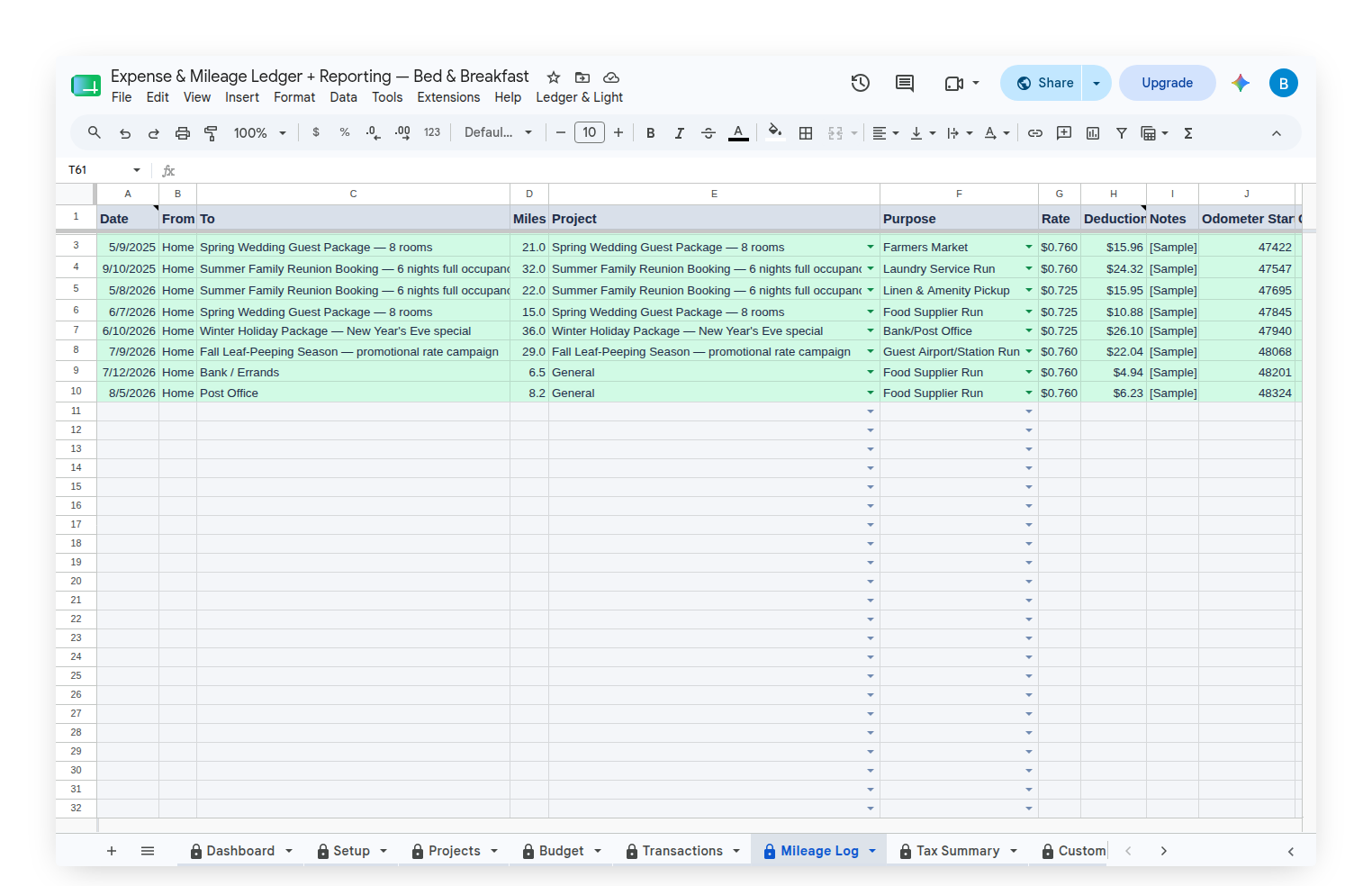
The run to the food supplier, the farmers' market before a full weekend, the bulk-linen and amenity pickup, the trip to collect a guest from the station — those are business miles, deductible as car and truck expenses on Schedule C Line 9 at the IRS standard mileage rate. They are also the easiest deduction in the whole list to lose, because each one is short and none of them produces a receipt. The Expense & Mileage Ledger and the Expense & Mileage Ledger + Reporting add a Mileage Form and a Mileage Log for exactly this: log the trip when it ends, with the date, the destination, and the purpose, and the year's total builds itself.
Vehicle & Mileage — Line 9, car and truck expenses. Every business drive in your own vehicle, claimed at the IRS standard mileage rate: the supplier and farmers' market runs, the bulk-linen and amenity pickups, the guest station and airport runs. The rate already covers fuel, maintenance, vehicle insurance and depreciation, so those costs do not also go here — the miles are the deduction.
Parking & Tolls — Line 9. The garage downtown during a supply run, the highway toll on a supplier trip, the meter at the station while you collect a guest. These are the one part of driving the standard rate does not absorb, which is why they are their own category and why they are deductible on top of the mileage figure rather than instead of it.
Logging it in the moment
Expense Ledger arrives with the bed and breakfast categories already built — the ones above, in the Expense Form's dropdown, mapped to the Schedule C lines they belong to. You fill in the merchant, amount, category and a short note from your phone, attach a receipt photo if you have the receipt in hand, and submit. That photo question is the one you put on the form yourself, following your setup instructions, because Google gives the setup script no way to create it. It takes a minute or two, and the entry lands in your sheet already sorted. The Transactions tab accumulates the year; the Tax Summary shows a running total for each Schedule C line, organized the way a return is organized.
When tax season comes, the Expense & Mileage Ledger + Reporting adds Email Tax Report, which sends your accountant the Tax Summary, the full transaction list, and the year's mileage log as PDFs in a single email, and Tab Export, which saves any individual tab to your Drive as a PDF or PNG, auto-named by year. Want to hand your accountant everything in one send? That is what the Expense & Mileage Ledger + Reporting does.
It is a one-time purchase with no subscription, and a single file holds around thirteen years of records. Every entry carries its own date — a past one included — so you can start in the middle of a season and each cost still lands in the right tax year.
The habit
Log the cost when the money goes out, choose the category, note what the spend was for when the house is doing double duty. Do that through the season and the return is already written: breakfast in cost of goods sold, linens and amenities in supplies, the platform commissions and the utilities and the insurance each sitting on their own line, and a mileage total nobody had to reconstruct. Your CPA has the final word on the allocation and on the treatment of any particular cost.